Ch. 22 The Digestive System
Amerman- Human Anatomy & Physiology 3e
Amerman3rd EditionHuman Anatomy & PhysiologyISBN: 9780138247201, 9780138247928, 9780138201814Not the one you use?Change textbook
Chapter 22, Problem 14c

Mark the following statements as true or false. If a statement is false, correct it to make a true statement.
c. Smooth muscle of the stomach contracts when food enters from the esophagus.

Verified step by step guidance
1
Step 1: Understand the role of smooth muscle in the stomach. Smooth muscle in the stomach is responsible for mixing and propelling food through the digestive tract via peristalsis and segmentation.
Step 2: Recall the process of food entering the stomach. When food passes from the esophagus into the stomach, it triggers the stomach's smooth muscle to contract, initiating mechanical digestion.
Step 3: Evaluate the statement provided. The statement claims that smooth muscle of the stomach contracts when food enters from the esophagus. Based on the physiological process, this is true.
Step 4: If the statement were false, you would need to correct it. For example, if the statement incorrectly claimed that smooth muscle does not contract, you would correct it to reflect the role of smooth muscle in initiating digestion.
Step 5: Conclude that the statement is true as written, and no correction is necessary in this case.

Verified video answer for a similar problem:

This video solution was recommended by our tutors as helpful for the problem above.
Video duration:
3m
Was this helpful?

Key Concepts

Here are the essential concepts you must grasp in order to answer the question correctly.

Smooth Muscle Function

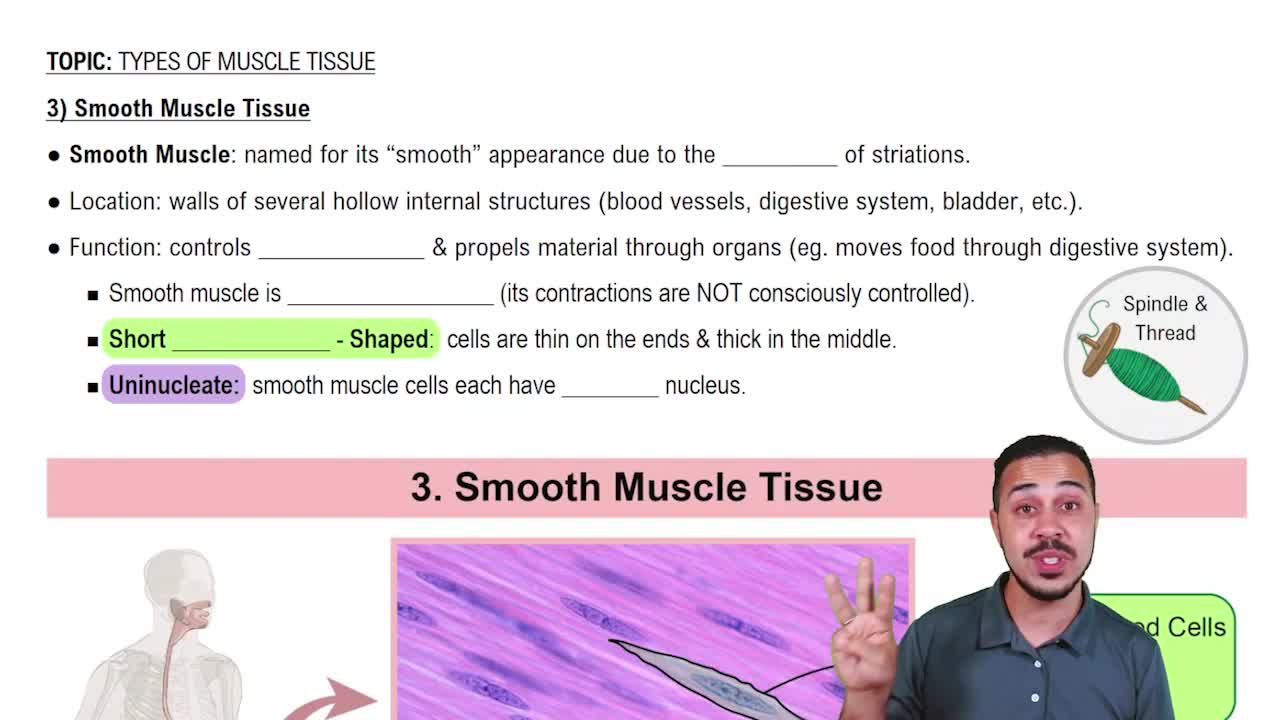
Smooth muscle is a type of involuntary muscle found in various organs, including the stomach. It is responsible for the peristaltic movements that help in the digestion of food. When food enters the stomach, smooth muscle contractions facilitate the mixing and propulsion of food through the digestive tract.
Recommended video:
Guided course
06:27
Smooth Muscle Tissue

Peristalsis

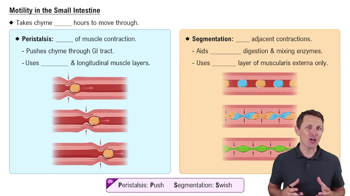
Peristalsis is a coordinated, wave-like muscle contraction that moves food through the digestive system. In the stomach, peristaltic contractions help mix food with gastric juices, aiding in digestion. This process is crucial for ensuring that food is properly broken down and moved along the gastrointestinal tract.
Recommended video:
Guided course
3:06
Motility in the Small Intestine

Gastrointestinal Response to Food

The gastrointestinal system responds to the presence of food through various mechanisms, including the release of hormones and the activation of smooth muscle. When food enters the stomach, it triggers reflexes that enhance muscle contractions, ensuring effective digestion and nutrient absorption. This response is essential for maintaining digestive health.
Recommended video:
9:59
Steps of the Interferon Response
Related Practice
Textbook Question

Which of the following best describes the role of bile salts in lipid digestion?

a. Bile salts begin chemical digestion of lipids.

b. Bile salts bind to lipids and physically break them apart into monoglycerides and free fatty acids.

c. Bile salts bind to lipids and physically break them apart into smaller pieces.

d. Bile salts interact with pancreatic lipase and catalyze lipid breakdown.

4
views
Textbook Question

The common hepatic duct and main pancreatic duct enter into the:

a. Pyloric sphincter

b. Duodenum

c. Ileum

d. Cecum

5
views
Textbook Question

Mark the following statements as true or false. If a statement is false, correct it to make a true statement.

e. During feeding, the small intestine exhibits motion in the migrating motor complex pattern.

2
views
Textbook Question

Mark the following statements as true or false. If a statement is false, correct it to make a true statement.

b. The esophageal and pharyngeal phases of swallowing are mediated by the swallowing reflex of the brainstem and the enteric nervous system.

Textbook Question

Which of the following best describes the microscopic structure of the liver?

a. Hexagonal plates of hepatocytes surrounding a central vein with portal triads at each corner

b. Octagonal plates of hepatocytes surrounding a central artery with portal triads at each corner

c. Irregular groups of hepatocytes surrounding a central vein with bile ducts at each corner

d. Hexagonal plates of hepatocytes surrounding a portal vein with bile ducts at each corner

4
views
Textbook Question

Which of the following statements about accessory organ secretions is not true?

a. Hepatocytes produce bile, which drains out of the liver via the common hepatic ducts.

b. Saliva contains secretory IgA and lysozyme, which play an important role in preventing the growth of pathogenic bacteria in the oral cavity.

c. Pancreatic juice contains digestive enzymes and bicarbonate ions to neutralize the acidic chyme.

d. The gallbladder produces bile, which drains out of the gallbladder via the cystic duct.

2
views