
Ch. 22 The Digestive System
Amerman- Human Anatomy & Physiology 3e
Amerman3rd EditionHuman Anatomy & PhysiologyISBN: 9780138247201, 9780138247928, 9780138201814Not the one you use?Change textbook
Chapter 22, Problem 16

The common hepatic duct and main pancreatic duct enter into the:
a. Pyloric sphincter
b. Duodenum
c. Ileum
d. Cecum

Verified step by step guidance
1
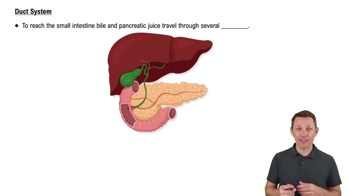
Understand the anatomy of the digestive system and the role of ducts in transporting bile and pancreatic enzymes. The common hepatic duct carries bile from the liver, and the main pancreatic duct carries digestive enzymes from the pancreas.
Identify the location where these ducts merge or enter the digestive tract. Both ducts join at the hepatopancreatic ampulla (also known as the ampulla of Vater) before entering the small intestine.
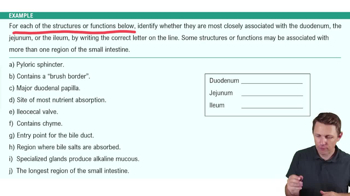
Recall the sections of the small intestine: duodenum, jejunum, and ileum. The duodenum is the first section of the small intestine and is the site where bile and pancreatic enzymes are released to aid digestion.
Eliminate incorrect options based on anatomical knowledge: The pyloric sphincter is part of the stomach, the ileum is the last section of the small intestine, and the cecum is part of the large intestine. None of these are involved in the entry of the common hepatic duct and main pancreatic duct.
Conclude that the correct answer is the duodenum, as it is the anatomical site where the common hepatic duct and main pancreatic duct release their contents into the digestive system.

Verified video answer for a similar problem:

This video solution was recommended by our tutors as helpful for the problem above.
Was this helpful?

Key Concepts

Here are the essential concepts you must grasp in order to answer the question correctly.

Common Hepatic Duct

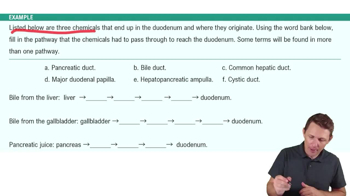
The common hepatic duct is a vital structure in the biliary system that carries bile from the liver. It merges with the cystic duct from the gallbladder to form the common bile duct, which plays a crucial role in digestion by delivering bile to the small intestine, particularly the duodenum.
Recommended video:

Main Pancreatic Duct

The main pancreatic duct, also known as the duct of Wirsung, transports digestive enzymes produced by the pancreas to the duodenum. This duct is essential for the proper digestion of food, as it allows the release of enzymes that break down carbohydrates, proteins, and fats.
Recommended video:
Guided course
2:59
Duct System of the Liver, Gallbladder, and Pancreas Example 1

Duodenum

The duodenum is the first section of the small intestine, immediately following the stomach. It is a critical site for digestion, where bile and pancreatic juices mix with chyme to facilitate the breakdown of nutrients. The entry point for both the common hepatic duct and the main pancreatic duct is located here, making it a key area for digestive processes.
Recommended video:
Guided course
3:38
Small Intestine Example 4
Related Practice
Textbook Question

Which of the following best describes the role of bile salts in lipid digestion?

a. Bile salts begin chemical digestion of lipids.

b. Bile salts bind to lipids and physically break them apart into monoglycerides and free fatty acids.

c. Bile salts bind to lipids and physically break them apart into smaller pieces.

d. Bile salts interact with pancreatic lipase and catalyze lipid breakdown.

4
views
Textbook Question

Lipids associate with bile salts in the small intestine to form_____ . In the enterocyte, lipids are packaged with other lipids into______.

2
views
Textbook Question

Mark the following statements as true or false. If a statement is false, correct it to make a true statement.

c. Smooth muscle of the stomach contracts when food enters from the esophagus.

4
views
Textbook Question

Mark the following statements as true or false. If a statement is false, correct it to make a true statement.

e. During feeding, the small intestine exhibits motion in the migrating motor complex pattern.

2
views
Textbook Question

The peritoneal cavity is located:

a. Around each of the digestive organs

b. Between layers of mesentery

c. Superior to the greater omentum

d. Between the parietal and visceral peritoneum

1
views
Textbook Question

Which of the following occurs/occur during the cephalic phase of gastric acid secretion?

a. Stimulation of gastrin and histamine release

b. Direct stimulation of parietal cells

c. Inhibition of somatostatin release

d. Both a and b are correct

e. All of the above are correct

1
views