
Ch. 21 The Respiratory System
Amerman- Human Anatomy & Physiology 3e
Amerman3rd EditionHuman Anatomy & PhysiologyISBN: 9780138247201, 9780138247928, 9780138201814Not the one you use?Change textbook
Chapter 21, Problem L2.1

Explain what would happen to the pressure inside a cylinder if you decreased its volume, according to Boyle's law.

Verified step by step guidance
1
Boyle's law states that the pressure of a gas is inversely proportional to its volume, provided the temperature and the amount of gas remain constant. This can be expressed mathematically as: PV=k, where P is pressure, V is volume, and k is a constant.
Rearrange the equation to show the relationship between pressure and volume: P=kV. This indicates that as volume (V) decreases, pressure (P) must increase to maintain the constant k.
To understand this conceptually, imagine compressing the gas in the cylinder. Decreasing the volume forces the gas particles into a smaller space, which increases the frequency of collisions between the particles and the walls of the cylinder, thereby increasing the pressure.
If you were to graph this relationship, you would see a hyperbolic curve where pressure increases as volume decreases, illustrating the inverse relationship.
In summary, according to Boyle's law, decreasing the volume of the cylinder will result in an increase in the pressure inside the cylinder, assuming temperature and the amount of gas remain constant.

Verified video answer for a similar problem:

This video solution was recommended by our tutors as helpful for the problem above.
Was this helpful?

Key Concepts

Here are the essential concepts you must grasp in order to answer the question correctly.

Boyle's Law

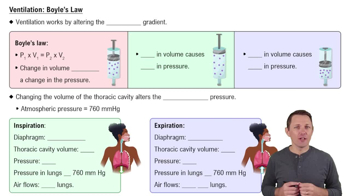
Boyle's Law states that the pressure of a gas is inversely proportional to its volume when the temperature is held constant. This means that if the volume of a gas decreases, the pressure increases, provided the amount of gas and temperature remain unchanged.
Recommended video:
Guided course
4:23
Ventilation: Boyle’s Law

Inversely Proportional Relationship

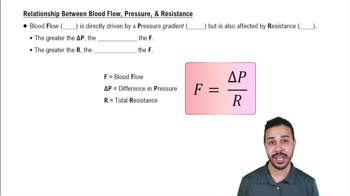
An inversely proportional relationship means that as one variable increases, the other decreases. In the context of Boyle's Law, when the volume of a gas decreases, the pressure increases, illustrating this fundamental relationship between pressure and volume.
Recommended video:
6:40
Relationship Between Blood Flow, Pressure, & Resistance

Ideal Gas Behavior

Ideal gas behavior refers to the theoretical model where gases follow the gas laws perfectly under all conditions. While real gases may deviate from this behavior at high pressures and low temperatures, Boyle's Law applies well to ideal gases, making it a useful approximation in many practical situations.
Recommended video:
Guided course
03:59
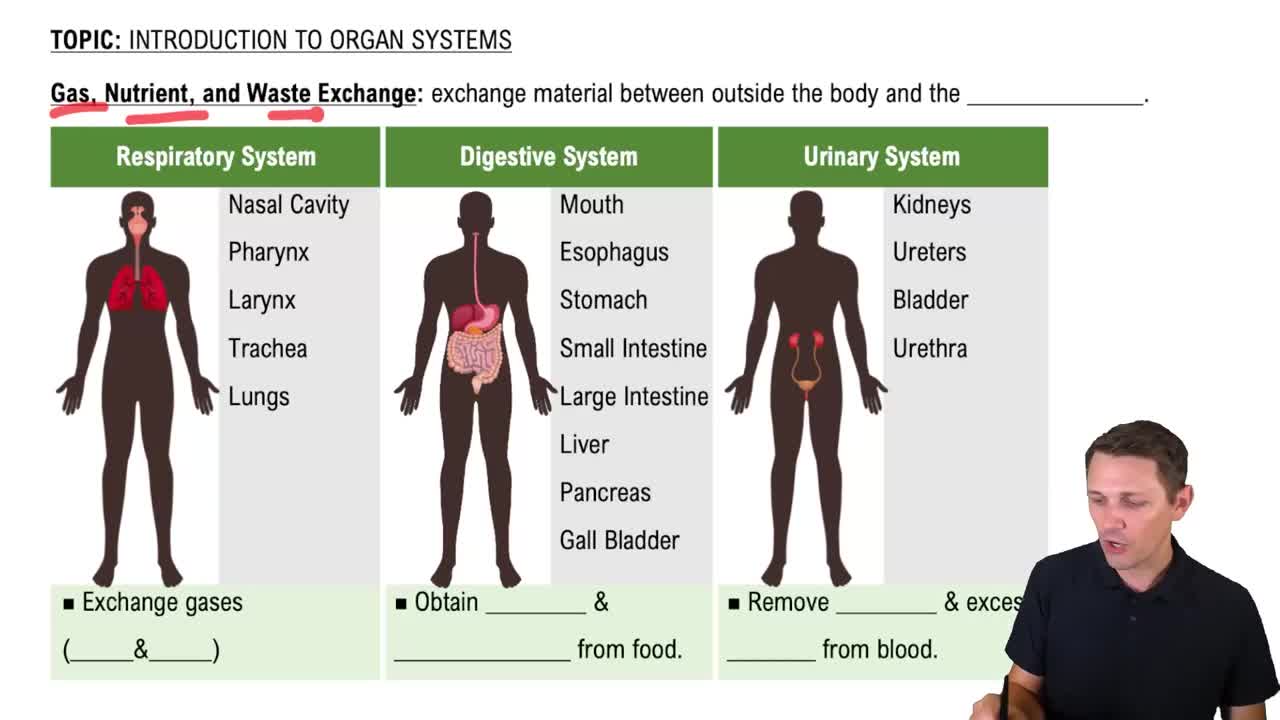
Gas, Nutrient and Waste Exchange