
Ch. 16 The Endocrine System
Amerman- Human Anatomy & Physiology 3e
Amerman3rd EditionHuman Anatomy & PhysiologyISBN: 9780138247201, 9780138247928, 9780138201814Not the one you use?Change textbook
Chapter 16, Problem 17

Which of the following statements about the adrenal medulla is false?
a. Secretion from the adrenal medulla is triggered by ACTH and the sympathetic nervous system.
b. The adrenal medulla consists of glandular epithelial cells.
c. The adrenal medulla is a modified postsynaptic sympathetic ganglion.
d. The products of the adrenal medulla prolong the effects of the sympathetic response.

Verified step by step guidance
1
Step 1: Begin by identifying the role and structure of the adrenal medulla. The adrenal medulla is the inner part of the adrenal gland and is responsible for secreting catecholamines (epinephrine and norepinephrine) in response to stress.
Step 2: Understand the mechanism of secretion. The adrenal medulla is stimulated by the sympathetic nervous system, specifically by preganglionic sympathetic neurons releasing acetylcholine. It is not directly triggered by ACTH (adrenocorticotropic hormone), which primarily affects the adrenal cortex.
Step 3: Examine the cellular composition of the adrenal medulla. It consists of chromaffin cells, which are modified postsynaptic sympathetic neurons, not glandular epithelial cells. This is a key distinction.
Step 4: Review the function of the adrenal medulla's secretions. The catecholamines (epinephrine and norepinephrine) released by the adrenal medulla enhance and prolong the effects of the sympathetic response, such as increasing heart rate and blood pressure.
Step 5: Compare each statement in the problem to the information above. Identify the false statement by noting that the adrenal medulla does not consist of glandular epithelial cells, making option 'b' the incorrect statement.

Verified video answer for a similar problem:

This video solution was recommended by our tutors as helpful for the problem above.
Was this helpful?

Key Concepts

Here are the essential concepts you must grasp in order to answer the question correctly.

Adrenal Medulla Function

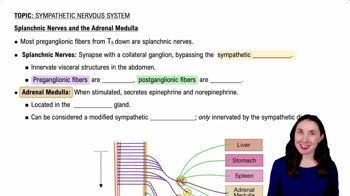
The adrenal medulla is the inner part of the adrenal glands and plays a crucial role in the body's fight-or-flight response. It secretes catecholamines, primarily adrenaline (epinephrine) and norepinephrine, which enhance the body's ability to respond to stress by increasing heart rate, blood flow, and energy availability.
Recommended video:
4:04
Splanchnic Nerves and the Adrenal Medulla

Sympathetic Nervous System

The sympathetic nervous system is part of the autonomic nervous system that prepares the body for stressful or emergency situations. It activates the adrenal medulla, leading to the release of hormones that amplify the body's physiological responses, such as increased heart rate and blood pressure, to prepare for rapid action.
Recommended video:
1:21
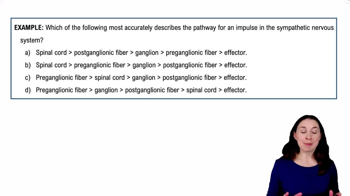
Sympathetic Nervous System Example 3

Hormonal Regulation

Hormonal regulation involves the control of physiological processes through hormones released into the bloodstream. In the context of the adrenal medulla, hormones like ACTH (adrenocorticotropic hormone) can influence its activity, although the primary trigger for catecholamine release is the sympathetic nervous system, highlighting the interplay between neural and hormonal signals.
Recommended video:
Guided course
13:06
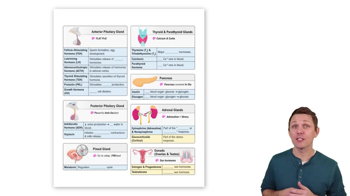
Review of Major Hormones
Related Practice
Textbook Question

Match the following hormones with their correct descriptions. 

Leptin      

Atrial natriuretic peptide      

Melatonin      

Estrogens      

Erythropoietin      

Testosterone

a. Produced by the pineal gland; regulates the sleep/wake cycle

b. Produced by the kidneys; regulates red blood cell production

c. Produced by the heart; promotes sodium ion loss in the kidneys and vasodilation

d. Produced by the testes; promotes androgenic and anabolic actions

e. Produced by adipose tissue; promotes satiety

f. Produced by the ovaries; regulate the menstrual cycle and the development of secondary sex characteristics

Textbook Question

Describe the components of the hypothalamic-pituitary-adrenocortical axis, and explain how it regulates secretion from the adrenal gland.

1
views
Textbook Question

Type 1 diabetes mellitus is characterized by______, and type 2 diabetes mellitus is characterized by_____.

a. hypoglycemia; destruction of the pancreatic β cells

b. destruction of the pancreatic β cells; destruction of the pancreatic α cells

c. insulin resistance; destruction of the pancreatic β cells

d. destruction of the pancreatic β cells; insulin resistance

2
views
Textbook Question

The hormone that directly stimulates the hunger center is:

a. Ghrelin

b. Cholecystokinin

c. Insulin

d. Leptin

1
views
Textbook Question

Explain how insulin and glucagon are antagonists.

1
views
Textbook Question

Which of the following hormones is not an integral part of the stress response?

a. Epinephrine

b. Cortisol

c. Insulin

d. Glucagon