Ch. 15 The Special Senses
Amerman- Human Anatomy & Physiology 3e
Amerman3rd EditionHuman Anatomy & PhysiologyISBN: 9780138247201, 9780138247928, 9780138201814Not the one you use?Change textbook
Chapter 15, Problem L3.1

Mr. Spencer suffers loss of taste sensation. Tests reveal that his taste buds and salivary glands are functional. What other structures might be impaired that would explain his loss of taste?

Verified step by step guidance
1
Step 1: Understand the anatomy of taste sensation. Taste sensation involves the taste buds, cranial nerves, and brain regions responsible for processing taste. Since the taste buds and salivary glands are functional, the issue likely lies in the neural pathways or brain regions.
Step 2: Identify the cranial nerves involved in taste. Taste sensation is primarily carried by three cranial nerves: the facial nerve (cranial nerve VII), glossopharyngeal nerve (cranial nerve IX), and vagus nerve (cranial nerve X). Damage to any of these nerves could impair taste sensation.
Step 3: Consider the role of the facial nerve (cranial nerve VII). This nerve carries taste sensations from the anterior two-thirds of the tongue. If this nerve is impaired, taste from this region would be affected.
Step 4: Consider the role of the glossopharyngeal nerve (cranial nerve IX). This nerve carries taste sensations from the posterior one-third of the tongue. Damage to this nerve could result in loss of taste from this region.
Step 5: Evaluate the central processing of taste. Taste signals are processed in the brainstem and relayed to the gustatory cortex in the brain. Damage to the brainstem or gustatory cortex could disrupt the perception of taste even if the peripheral structures are intact.

Verified video answer for a similar problem:

This video solution was recommended by our tutors as helpful for the problem above.
Was this helpful?

Key Concepts

Here are the essential concepts you must grasp in order to answer the question correctly.

Taste Pathways

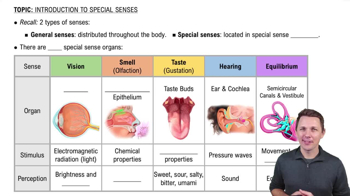
Taste sensation is primarily transmitted through specific cranial nerves, particularly the facial nerve (VII), glossopharyngeal nerve (IX), and vagus nerve (X). These nerves carry taste information from the taste buds to the brain. If any of these pathways are damaged or impaired, it can lead to a loss of taste sensation, even if the taste buds themselves are functioning properly.
Recommended video:
4:40
Alternative Pathway

Central Processing of Taste

The brain processes taste information in the gustatory cortex, located in the insula and frontal operculum. Damage to this area can disrupt the perception of taste, leading to conditions such as ageusia (complete loss of taste) or dysgeusia (distorted taste). Understanding the role of the central nervous system in taste perception is crucial for diagnosing taste disorders.
Recommended video:
05:45
Central Dogma

Role of Olfaction in Taste

Taste and smell are closely linked, with olfaction playing a significant role in flavor perception. The olfactory bulb processes smells that contribute to the overall taste experience. If Mr. Spencer has an impairment in his olfactory system, it could significantly affect his ability to perceive taste, even if his taste buds are intact.
Recommended video:
Guided course
5:05
Special Senses