Ch. 15 The Special Senses
Amerman- Human Anatomy & Physiology 3e
Amerman3rd EditionHuman Anatomy & PhysiologyISBN: 9780138247201, 9780138247928, 9780138201814Not the one you use?Change textbook
Chapter 15, Problem L2.3

If a patient suffers visual impairment only in one eye, why must the damage be located in the visual pathway prior to the optic chiasma?

Verified step by step guidance
1
Understand the anatomy of the visual pathway: The visual pathway begins at the retina in each eye, where light signals are converted into neural signals. These signals travel through the optic nerve, which carries information from each eye to the brain. The optic nerves from both eyes meet at the optic chiasma, where some fibers cross to the opposite side.
Recognize the role of the optic chiasma: At the optic chiasma, the nerve fibers from the nasal (inner) half of each retina cross over to the opposite side of the brain, while the fibers from the temporal (outer) half of each retina remain on the same side. This crossing allows for binocular vision and processing of visual information from both eyes.
Analyze the implications of damage before the optic chiasma: If the damage occurs before the optic chiasma, it affects the optic nerve of only one eye. This means that visual information from the affected eye cannot reach the brain, leading to visual impairment in that eye alone.
Contrast damage after the optic chiasma: Damage occurring after the optic chiasma affects fibers that have already crossed or remained on the same side. This typically results in visual field deficits in both eyes, such as hemianopia (loss of half the visual field), rather than impairment in just one eye.
Conclude why the damage must be prior to the optic chiasma: Since the visual impairment is isolated to one eye, the damage must be located in the optic nerve of that eye, prior to the optic chiasma, where the fibers from both eyes begin to mix and cross.

Verified video answer for a similar problem:

This video solution was recommended by our tutors as helpful for the problem above.
Was this helpful?

Key Concepts

Here are the essential concepts you must grasp in order to answer the question correctly.

Visual Pathway

The visual pathway refers to the neural route that visual information takes from the retina to the brain. It includes structures such as the optic nerve, optic chiasma, and visual cortex. Understanding this pathway is crucial for diagnosing visual impairments, as damage at different points can lead to specific visual deficits.
Recommended video:
4:40
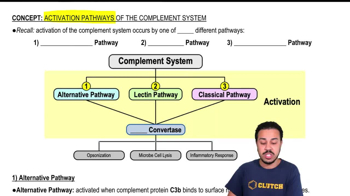
Alternative Pathway

Optic Chiasma

The optic chiasma is the point where the optic nerves from both eyes partially cross. This crossing allows visual information from the right visual field to be processed by the left hemisphere of the brain and vice versa. Damage occurring before this point affects only one eye, while damage after affects both eyes.
Recommended video:
Guided course
5:04
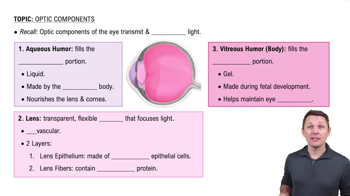
Optic Components

Unilateral Visual Impairment

Unilateral visual impairment refers to vision loss in one eye. This condition can result from various issues, such as retinal detachment or optic nerve damage. Recognizing that such impairment indicates a problem in the visual pathway before the optic chiasma is essential for accurate diagnosis and treatment.
Recommended video:
3:32
Introduction to the Lymphatic System Example 2