
Ch. 14 The Autonomic Nervous System and Homeostasis
Amerman- Human Anatomy & Physiology 3e
Amerman3rd EditionHuman Anatomy & PhysiologyISBN: 9780138247201, 9780138247928, 9780138201814Not the one you use?Change textbook
Chapter 14, Problem 5

Which neurotransmitter(s) is/are used by sympathetic postganglionic neurons?


a. Epinephrine
b. Norepinephrine
c. Acetylcholine
d. Both a and b
e. All of the above

Verified step by step guidance
1
Understand the role of the sympathetic nervous system: The sympathetic nervous system is part of the autonomic nervous system and is responsible for the 'fight or flight' response. It uses neurotransmitters to communicate between neurons and target tissues.
Identify the neurotransmitters used by sympathetic postganglionic neurons: Sympathetic postganglionic neurons primarily release norepinephrine (NE) as their neurotransmitter to activate target tissues. However, in some cases, epinephrine (E) can also be involved, especially when released by the adrenal medulla.
Recognize exceptions: While norepinephrine is the primary neurotransmitter, acetylcholine (ACh) is used by sympathetic postganglionic neurons in specific cases, such as sweat glands.
Analyze the options provided: Option a (epinephrine) and option b (norepinephrine) are correct because both are used in the sympathetic system. Option c (acetylcholine) is correct in specific cases. Option d (both a and b) is correct because norepinephrine and epinephrine are both used. Option e (all of the above) is correct because all three neurotransmitters are involved in different contexts.
Conclude based on the context: To determine the correct answer, consider the primary neurotransmitter (norepinephrine), the secondary neurotransmitter (epinephrine), and the exception (acetylcholine). This will help you select the most accurate option from the list.

Verified video answer for a similar problem:

This video solution was recommended by our tutors as helpful for the problem above.
Was this helpful?

Key Concepts

Here are the essential concepts you must grasp in order to answer the question correctly.

Sympathetic Nervous System

The sympathetic nervous system is a part of the autonomic nervous system responsible for the body's 'fight or flight' response. It prepares the body for stressful situations by increasing heart rate, dilating pupils, and redirecting blood flow to essential organs. Understanding its role is crucial for identifying the neurotransmitters involved in sympathetic postganglionic signaling.
Recommended video:
1:21
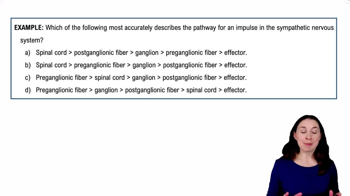
Sympathetic Nervous System Example 3

Neurotransmitters

Neurotransmitters are chemical messengers that transmit signals across synapses between neurons. In the context of the sympathetic nervous system, norepinephrine is the primary neurotransmitter released by postganglionic neurons, while epinephrine is released from the adrenal medulla into the bloodstream. Recognizing the specific neurotransmitters involved is essential for answering the question accurately.
Recommended video:
2:30
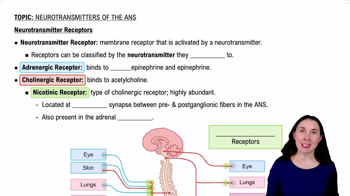
Neurotransmitter Receptors

Postganglionic Neurons

Postganglionic neurons are the second set of neurons in the autonomic nervous system pathway, which transmit signals from ganglia to target organs. In the sympathetic nervous system, these neurons primarily release norepinephrine, although some may release acetylcholine in specific cases. Understanding the function and neurotransmitter release of these neurons is key to determining the correct answer to the question.
Recommended video:
Related Practice
Textbook Question

Many chemical warfare agents, such as the poisonous gas sarin, block the enzyme acetylcholinesterase in the synaptic cleft. What effects will this poison have on muscle contraction? What effects will it have on the autonomic nervous system? What symptoms would you expect to see from this poison?

1
views
Textbook Question

Which of the following actions would you expect when sympathetic neurons release norepinephrine onto β1 receptors?

a. Decreased sweat production

b. Constriction of blood vessels serving the digestive, urinary, and integumentary systems

c. Adjustment of the shape of the lens

d. Increase in the rate and force of contraction of the heart.

3
views
Textbook Question

Differentiate between adrenergic and cholinergic receptors.

5
views
Textbook Question

Mark each of the following as an effect of the sympathetic nervous system or the parasympathetic nervous system.

a. ________ Bronchodilation

b.________ Bronchoconstriction

c. ________ Constriction of pupil

d. ________ Vasoconstriction of blood vessels serving organs of digestive, urinary, and integumentary systems

e. ________ Increased metabolic rate

f. ________ Dilation of pupil

g.________ Contraction of smooth muscle of digestive tract

5
views
Textbook Question

Explain what happens when sympathetic neurons stimulate the adrenal medulla. What purpose does this serve?

1
views
Textbook Question

The poison curare (kyoo-RAH-ray) blocks the binding of acetylcholine to its receptors at the neuromuscular junction. What effects would you predict from such a poison? Can you think of any useful applications for it? Why might an overdose of it be lethal?

3
views