Ch. 14 The Autonomic Nervous System and Homeostasis
Amerman- Human Anatomy & Physiology 3e
Amerman3rd EditionHuman Anatomy & PhysiologyISBN: 9780138247201, 9780138247928, 9780138201814Not the one you use?Change textbook
Chapter 14, Problem 6

Explain what happens when sympathetic neurons stimulate the adrenal medulla. What purpose does this serve?

Verified step by step guidance
1
Sympathetic neurons release acetylcholine at the synapse with the adrenal medulla's chromaffin cells, which are specialized neuroendocrine cells.
The acetylcholine binds to nicotinic receptors on the chromaffin cells, triggering a cascade of intracellular signaling that leads to the release of catecholamines.
The adrenal medulla secretes two primary catecholamines: epinephrine (adrenaline) and norepinephrine (noradrenaline), directly into the bloodstream.
These catecholamines act as hormones, traveling through the blood to target tissues, where they bind to adrenergic receptors and initiate the 'fight or flight' response.
The purpose of this response is to prepare the body for immediate action by increasing heart rate, dilating airways, mobilizing energy stores, and redirecting blood flow to essential organs like muscles and the brain.

Verified video answer for a similar problem:

This video solution was recommended by our tutors as helpful for the problem above.
Was this helpful?

Key Concepts

Here are the essential concepts you must grasp in order to answer the question correctly.

Sympathetic Nervous System

The sympathetic nervous system is a part of the autonomic nervous system responsible for the body's 'fight or flight' response. It prepares the body to respond to stress or danger by increasing heart rate, dilating airways, and redirecting blood flow to essential organs. This system is activated during stressful situations, leading to physiological changes that enhance survival.
Recommended video:
1:21
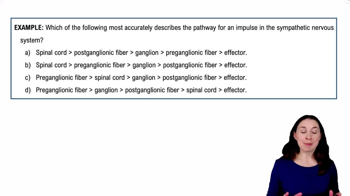
Sympathetic Nervous System Example 3

Adrenal Medulla

The adrenal medulla is the inner part of the adrenal glands, which are located on top of each kidney. It plays a crucial role in the stress response by secreting hormones such as adrenaline (epinephrine) and norepinephrine into the bloodstream. These hormones amplify the effects of the sympathetic nervous system, leading to increased energy availability and heightened alertness.
Recommended video:
4:04
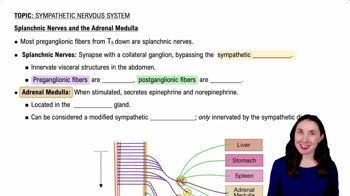
Splanchnic Nerves and the Adrenal Medulla

Hormonal Response to Stress

When sympathetic neurons stimulate the adrenal medulla, they trigger the release of catecholamines, primarily adrenaline and norepinephrine. This hormonal response enhances the body's ability to cope with stress by increasing heart rate, blood pressure, and energy production. It serves to prepare the body for immediate physical action, ensuring that it can respond effectively to perceived threats.
Recommended video:
Guided course
13:06
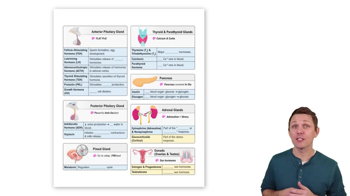
Review of Major Hormones
Related Practice
Textbook Question

Which neurotransmitter(s) is/are used by sympathetic postganglionic neurons?


a. Epinephrine

b. Norepinephrine

c. Acetylcholine

d. Both a and b

e. All of the above

1
views

Textbook Question

Many chemical warfare agents, such as the poisonous gas sarin, block the enzyme acetylcholinesterase in the synaptic cleft. What effects will this poison have on muscle contraction? What effects will it have on the autonomic nervous system? What symptoms would you expect to see from this poison?

1
views
Textbook Question

Which of the following actions would you expect when sympathetic neurons release norepinephrine onto β1 receptors?

a. Decreased sweat production

b. Constriction of blood vessels serving the digestive, urinary, and integumentary systems

c. Adjustment of the shape of the lens

d. Increase in the rate and force of contraction of the heart.

3
views
Textbook Question

Mark the following statements as true or false. If a statement is false, correct it to make a true statement.

a. The parasympathetic nervous system generally decreases the secretion from digestive glands.

7
views
Textbook Question

Differentiate between adrenergic and cholinergic receptors.

5
views
Textbook Question

Mark each of the following as an effect of the sympathetic nervous system or the parasympathetic nervous system.

a. ________ Bronchodilation

b.________ Bronchoconstriction

c. ________ Constriction of pupil

d. ________ Vasoconstriction of blood vessels serving organs of digestive, urinary, and integumentary systems

e. ________ Increased metabolic rate

f. ________ Dilation of pupil

g.________ Contraction of smooth muscle of digestive tract

5
views