

Ch. 25 Fluid, Electrolyte, and Acid-Base Homeostasis
Amerman - Human Anatomy & Physiology 2nd Edition
Amerman2nd EditionHuman Anatomy & PhysiologyISBN: 9780136873822Not the one you use?Change textbook
Chapter 25, Problem L3.4

A laboratory printout of arterial blood gases indicates that a patient has an increased Pco₂ , decreased pH, and normal bicarbonate ion concentration. Is this patient in acidosis or alkalosis? Is the pH disturbance respiratory or metabolic in nature? Explain your reasoning. How long do you think the patient has had this pH disturbance? (Hint: Look at the bicarbonate ion concentration. What system controls the concentration of bicarbonate ions, and how quickly does it compensate for pH disturbances?)

Verified step by step guidance
1
Step 1: Begin by analyzing the arterial blood gas (ABG) values provided. The increased Pco₂ (partial pressure of carbon dioxide) and decreased pH indicate that the blood is more acidic than normal. This condition is referred to as acidosis because the pH is below the normal range (7.35–7.45).
Step 2: Determine whether the acidosis is respiratory or metabolic in nature. Since the Pco₂ is elevated, this suggests that the acidosis is respiratory in origin. Elevated Pco₂ indicates hypoventilation or impaired gas exchange, leading to carbon dioxide retention, which lowers the pH.
Step 3: Evaluate the bicarbonate ion (HCO₃⁻) concentration. The problem states that the bicarbonate ion concentration is normal. This suggests that the kidneys have not yet compensated for the pH disturbance by increasing bicarbonate levels, which would help buffer the excess acidity.
Step 4: Use the hint provided to estimate the duration of the pH disturbance. The bicarbonate ion concentration is regulated by the renal system, which typically takes hours to days to compensate for pH disturbances. Since the bicarbonate level is still normal, it is likely that the disturbance is acute and has not been present long enough for renal compensation to occur.
Step 5: Summarize the findings. The patient is in respiratory acidosis due to elevated Pco₂ and decreased pH. The normal bicarbonate level indicates that the disturbance is acute, as the renal system has not yet had time to compensate. This conclusion aligns with the physiological mechanisms of acid-base balance.

Verified video answer for a similar problem:

This video solution was recommended by our tutors as helpful for the problem above.
Was this helpful?

Key Concepts

Here are the essential concepts you must grasp in order to answer the question correctly.

Acidosis and Alkalosis

Acidosis refers to a condition where the blood pH is lower than the normal range (7.35-7.45), indicating an excess of hydrogen ions. Conversely, alkalosis occurs when the pH is higher than normal, suggesting a deficiency of hydrogen ions. In the context of the question, the increased Pco₂ and decreased pH suggest that the patient is experiencing acidosis.
Recommended video:
Guided course
03:46
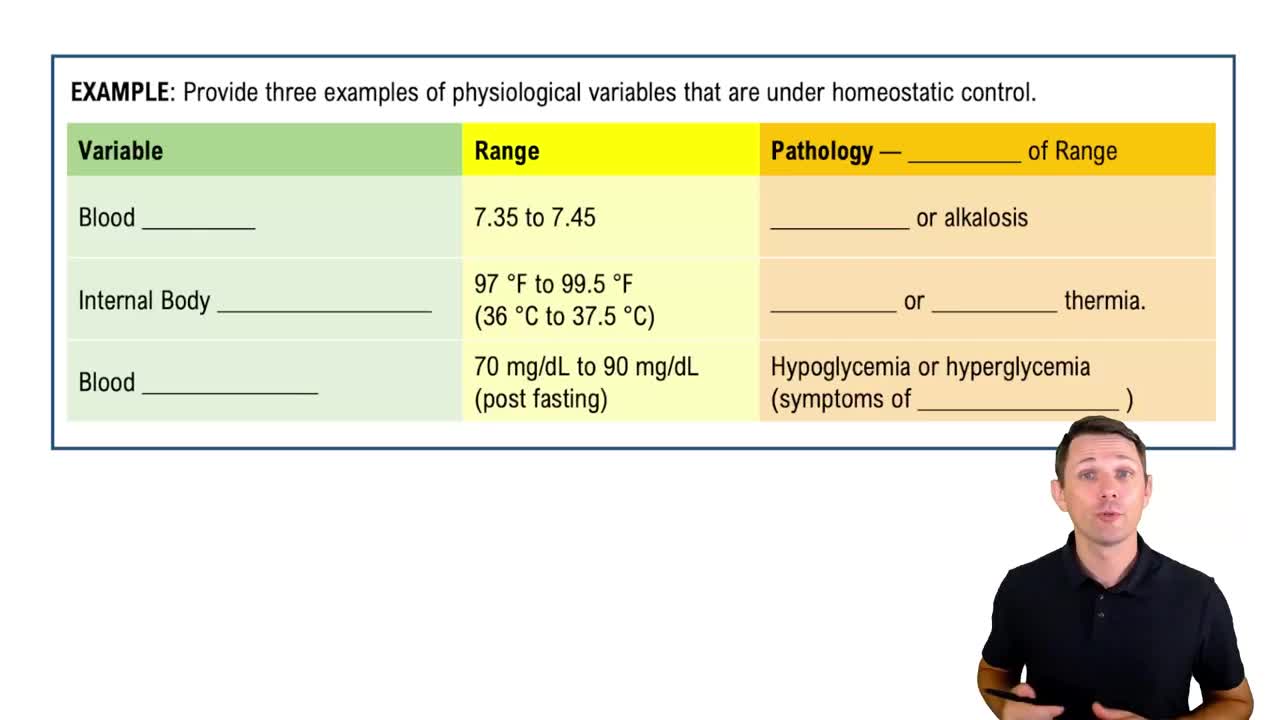
Homeostasis Example 1

Respiratory vs. Metabolic Disturbances

Respiratory disturbances are related to changes in carbon dioxide levels due to lung function, while metabolic disturbances involve changes in bicarbonate levels or other metabolic processes. The question indicates a respiratory acidosis due to elevated Pco₂, which suggests that the lungs are not effectively removing carbon dioxide, leading to a decrease in pH.
Recommended video:
02:17
Introduction to Metabolism

Bicarbonate Ion Concentration and Compensation

Bicarbonate ions (HCO₃⁻) play a crucial role in maintaining acid-base balance in the body. The kidneys regulate bicarbonate concentration, but this process is slower than respiratory compensation. In the scenario presented, the normal bicarbonate level indicates that the patient has likely had this acidosis for a shorter duration, as the kidneys have not yet had time to adjust bicarbonate levels significantly.
Recommended video:
04:51
Concentration Gradients and Diffusion
Related Practice
Textbook Question

Elise Anderson is a 6-year-old girl who presents to the emergency department with a history of vomiting for the past 3 days. The nurse notices that her respiratory rate is abnormally low. What is the likely reason for this change in ventilation? Predict what Elise's arterial blood gas values would show.

1
views
Textbook Question

What do you think has happened to Elise's ECF volume and osmolarity over the past 3 days? Will this lead to a change in the volume of water in the cytosol of her cells? Explain.

1
views
Textbook Question

As a percentage of body weight, the total body water tends to be higher in ________ and lower in ________ .

a. infants; men

b. women; men

c. men; infants

d. infants; women

2
views
Textbook Question

A cell in a/an ________ fluid will lose water, and a cell in a/an ________ fluid will gain water.

1
views
Textbook Question

Ms. Johanssen is a patient in the hospital. The nurse examines her laboratory reports and notices that she has developed hyperkalemia and acidosis over the past several days. On closer examination of her medical chart, the nurse also sees that her physician recently doubled her dose of spironolactone, an aldosterone-blocking diuretic. How does this explain her laboratory findings?

1
views
Textbook Question

What happens to the concentration of sodium ions in the ECF if you consume a large amount of salt without consuming any water? How will this affect the osmotic pressure of the ECF? Why could this lead to an elevation in blood pressure?

5
views