Ch. 25 Fluid, Electrolyte, and Acid-Base Homeostasis
Amerman - Human Anatomy & Physiology 2nd Edition
Amerman2nd EditionHuman Anatomy & PhysiologyISBN: 9780136873822Not the one you use?Change textbook
Chapter 25, Problem 5

A cell in a/an ________ fluid will lose water, and a cell in a/an ________ fluid will gain water.

Verified step by step guidance
1
Step 1: Understand the concept of tonicity, which refers to the ability of a surrounding solution to cause a cell to gain or lose water. Tonicity is determined by the concentration of solutes in the solution relative to the solutes inside the cell.
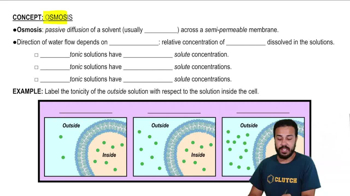
Step 2: Define the three types of solutions based on tonicity: hypertonic, hypotonic, and isotonic. A hypertonic solution has a higher solute concentration than the cell, a hypotonic solution has a lower solute concentration than the cell, and an isotonic solution has an equal solute concentration to the cell.
Step 3: Analyze the behavior of water movement in a hypertonic solution. Water moves out of the cell into the surrounding solution due to osmosis, causing the cell to lose water and shrink (crenation in animal cells).
Step 4: Analyze the behavior of water movement in a hypotonic solution. Water moves into the cell from the surrounding solution due to osmosis, causing the cell to gain water and potentially swell or burst (lysis in animal cells).
Step 5: Fill in the blanks based on the above analysis: A cell in a hypertonic fluid will lose water, and a cell in a hypotonic fluid will gain water.

Verified video answer for a similar problem:

This video solution was recommended by our tutors as helpful for the problem above.
Was this helpful?

Key Concepts

Here are the essential concepts you must grasp in order to answer the question correctly.

Osmosis

Osmosis is the movement of water across a semipermeable membrane from an area of lower solute concentration to an area of higher solute concentration. This process is crucial for maintaining cell turgor and overall homeostasis. Understanding osmosis helps explain how cells interact with their surrounding fluids, particularly in terms of water loss and gain.
Recommended video:
05:59
Osmosis

Hypertonic Solution

A hypertonic solution has a higher concentration of solutes compared to the inside of a cell. When a cell is placed in a hypertonic solution, water moves out of the cell to balance solute concentrations, leading to cell shrinkage or crenation. This concept is essential for understanding why cells lose water in certain environments.
Recommended video:
02:19
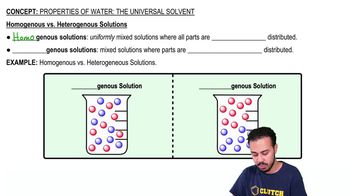
Homogenous vs. Heterogenous Solutions

Hypotonic Solution

A hypotonic solution has a lower concentration of solutes than the inside of a cell. When a cell is immersed in a hypotonic solution, water enters the cell, causing it to swell and potentially burst. This concept is vital for understanding how cells gain water and the effects of different fluid environments on cellular integrity.
Recommended video:
02:19
Homogenous vs. Heterogenous Solutions
Related Practice
Textbook Question

As a percentage of body weight, the total body water tends to be higher in ________ and lower in ________ .

a. infants; men

b. women; men

c. men; infants

d. infants; women

2
views

Textbook Question

A laboratory printout of arterial blood gases indicates that a patient has an increased Pco₂ , decreased pH, and normal bicarbonate ion concentration. Is this patient in acidosis or alkalosis? Is the pH disturbance respiratory or metabolic in nature? Explain your reasoning. How long do you think the patient has had this pH disturbance? (Hint: Look at the bicarbonate ion concentration. What system controls the concentration of bicarbonate ions, and how quickly does it compensate for pH disturbances?)

1
views
Textbook Question

Mark the following statements as true or false. If a statement is false, correct it to make a true statement.

b. The sensible water loss includes the water lost from the body via the skin and the respiratory system.

1
views
Textbook Question

Mark the following statements as true or false. If a statement is false, correct it to make a true statement.

c. The main hormone that regulates fluid balance is antidiuretic hormone (ADH).

1
views
Textbook Question

Ms. Johanssen is a patient in the hospital. The nurse examines her laboratory reports and notices that she has developed hyperkalemia and acidosis over the past several days. On closer examination of her medical chart, the nurse also sees that her physician recently doubled her dose of spironolactone, an aldosterone-blocking diuretic. How does this explain her laboratory findings?

1
views
Textbook Question

Mark the following statements as true or false. If a statement is false, correct it to make a true statement.

a. The thirst mechanism is mediated by osmoreceptors located in the cerebral cortex.

6
views