Back
BackAnatomy & Physiology: Foundations of the Human Body (Chapters 1–3 Study Guide)
Study Guide - Smart Notes
 Tailored notes based on your materials, expanded with key definitions, examples, and context.
Introduction to Anatomy & Physiology
Definition and Relationship of Anatomy and Physiology
Anatomy is the study of the structure of body parts and their relationships, while physiology is the study of the function of those parts. The two disciplines are closely related, as the structure of a body part often determines its function—a concept known as the principle of complementarity.
Gross (macroscopic) anatomy: Study of structures visible to the naked eye (regional, systemic, surface anatomy).
Microscopic anatomy: Study of structures too small to be seen without magnification (cytology, histology).
Developmental anatomy: Study of structural changes throughout the lifespan (embryology focuses on prenatal development).
Specialized branches: Pathological and radiographic anatomy.
Physiology focuses on the function of specific organ systems, often at the cellular or molecular level, and applies principles of physics and chemistry.
Example: The structure of the heart (anatomy) enables it to pump blood (physiology).
Levels of Structural Organization
The human body is organized into hierarchical levels, each building on the previous:
Chemical level: Atoms combine to form molecules, which form organelles.
Cellular level: Cells are the basic unit of life.
Tissue level: Groups of similar cells with a common function.
Organ level: Discrete structures composed of at least two tissue types.
Organ system level: Organs working together for a common purpose.
Organismal level: The living human being as a whole.
The body has 11 organ systems, each with specific functions (e.g., integumentary, skeletal, muscular, nervous, endocrine, cardiovascular, lymphatic/immune, respiratory, digestive, urinary, reproductive).
Cell Chemistry & Cell Components
Matter, Energy, and Chemical Bonds
Matter is anything that occupies space and has mass. Energy is the capacity to do work and exists as kinetic (movement) or potential (stored) energy. The body uses chemical, electrical, mechanical, and radiant energy forms.
Atoms: Smallest unit of an element, composed of protons, neutrons, and electrons.
Elements: Substances that cannot be broken down by ordinary means; four elements (C, H, O, N) make up 96% of body mass.
Compounds vs. Mixtures: Compounds are chemically bonded; mixtures are physically combined and can be separated by physical means.
Chemical bonds: Ionic (transfer of electrons), covalent (sharing electrons), hydrogen (weak attractions).
Example: Water (H2O) is a compound formed by covalent bonds between hydrogen and oxygen.
Biomolecules: Carbohydrates, Lipids, Proteins, Nucleic Acids
Carbohydrates: Main energy source; includes monosaccharides, disaccharides, polysaccharides.
Lipids: Energy storage, insulation, cell membranes; includes triglycerides, phospholipids, steroids.
Proteins: Structural material, enzymes, transport; composed of amino acids, four levels of structure (primary, secondary, tertiary, quaternary).
Nucleic acids: DNA and RNA store and transmit genetic information; ATP is the energy currency of the cell.
Energy & Cell Processes
Cellular Metabolism and ATP
Metabolism encompasses all chemical reactions in the body, including anabolic (building) and catabolic (breaking down) processes. ATP (adenosine triphosphate) is the primary energy carrier, transferring energy via phosphorylation to drive cellular work (transport, mechanical, chemical).
Enzymes: Biological catalysts that lower activation energy and speed up reactions.
Oxidation-reduction reactions: Involve electron transfer; essential for energy production.
Tissues & Histology
Cell Structure and Function
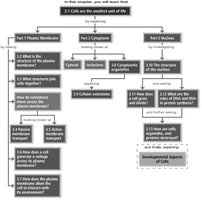
Cells are the smallest unit of life, with three main regions: plasma membrane, cytoplasm, and nucleus. Extracellular materials include fluids, secretions, and the extracellular matrix.
Plasma Membrane Structure
The plasma membrane is a double layer of phospholipids with embedded proteins, forming a selectively permeable barrier. The fluid mosaic model describes its dynamic nature.
Phospholipids: Hydrophilic heads face outward; hydrophobic tails face inward.
Proteins: Integral (span membrane, transport) and peripheral (enzymes, support).
Glycocalyx: Carbohydrate-rich area for cell recognition.
Intercellular Junctions
Tight junctions: Prevent passage between cells.
Desmosomes: Anchor cells together.
Gap junctions: Allow communication via small molecules.
Membrane Transport
Passive transport: Diffusion (simple, facilitated), osmosis (water movement).
Active transport: Uses ATP to move substances against gradients (primary, secondary).
Vesicular transport: Endocytosis (phagocytosis, pinocytosis, receptor-mediated), exocytosis.
Membrane Potential
The resting membrane potential is a voltage across the membrane, mainly due to potassium ion gradients, maintained by active transport pumps.
Cell Communication
Cell adhesion molecules (CAMs): Attach cells, guide movement, signal immune cells.
Membrane receptors: Mediate contact and chemical signaling (e.g., G protein-coupled receptors).
Cell Components and Organelles
Cytoplasm and Organelles
Mitochondria: ATP production.
Ribosomes: Protein synthesis.
Endoplasmic reticulum (ER): Rough ER (protein synthesis), smooth ER (lipid metabolism, detoxification).
Golgi apparatus: Modifies, packages, and ships proteins/lipids.
Lysosomes: Digestive enzymes for breakdown.
Peroxisomes: Detoxification.
Cytoskeleton: Structural support, movement (microfilaments, intermediate filaments, microtubules).
Centrosome/centrioles: Organize microtubules, cell division.
Cellular Extensions
Cilia: Motile, move substances across surfaces.
Flagella: Propel cells (e.g., sperm).
Microvilli: Increase surface area for absorption.
Nucleus and Cell Division
Nuclear Structure
Nuclear envelope: Double membrane with pores.
Nucleolus: Ribosome assembly.
Chromatin: DNA, histones, RNA; condenses to chromosomes during division.
Cell Cycle and Division
Interphase: G1 (growth), S (DNA synthesis), G2 (preparation for division).
Mitosis: Prophase, metaphase, anaphase, telophase.
Cytokinesis: Division of cytoplasm.
Protein Synthesis
Transcription: DNA to mRNA in nucleus.
Translation: mRNA to protein at ribosome (involves tRNA, rRNA).
Genetic code: Triplets (DNA), codons (mRNA), anticodons (tRNA).
Cellular Cleanup and Death
Autophagy: Digestion of cell parts via lysosomes.
Ubiquitin-proteasome pathway: Protein degradation.
Apoptosis: Programmed cell death.
Developmental Aspects of Cells
Cell differentiation: Specialization during development.
Cell aging: Theories include wear-and-tear, mitochondrial, immune, and genetic (telomere shortening).