Ch. 24 The Urinary System
Amerman - Human Anatomy & Physiology 2nd Edition
Amerman2nd EditionHuman Anatomy & PhysiologyISBN: 9780136873822Not the one you use?Change textbook
Chapter 24, Problem L2.2

Trace the pathway taken by a molecule of urea through the kidney from the glomerulus to the renal pelvis if the urea is recycled.

Verified step by step guidance
1
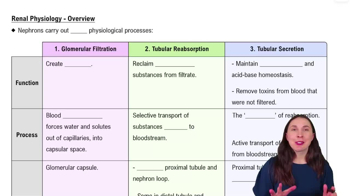
Start at the glomerulus: Urea is filtered from the blood plasma into the Bowman's capsule as part of the filtrate during the process of glomerular filtration.
Move to the proximal convoluted tubule: The filtrate, including urea, flows into the proximal convoluted tubule, where some water, ions, and nutrients are reabsorbed, but urea remains in the filtrate.
Proceed to the loop of Henle: The filtrate travels down the descending limb and up the ascending limb of the loop of Henle. Here, water is reabsorbed in the descending limb, and ions are reabsorbed in the ascending limb, concentrating the urea in the filtrate.
Enter the distal convoluted tubule and collecting duct: Urea continues into the distal convoluted tubule and then into the collecting duct. In the collecting duct, some urea is reabsorbed into the interstitial fluid of the renal medulla, contributing to the medullary concentration gradient (urea recycling).
Finish at the renal pelvis: The remaining urea that is not reabsorbed flows with the urine through the collecting duct into the renal pelvis, where it is eventually excreted or recycled again depending on the body's needs.

Verified video answer for a similar problem:

This video solution was recommended by our tutors as helpful for the problem above.
Was this helpful?

Key Concepts

Here are the essential concepts you must grasp in order to answer the question correctly.

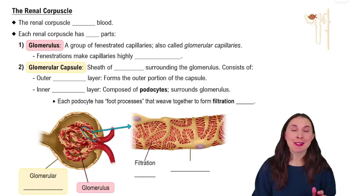
Glomerulus

The glomerulus is a network of capillaries located at the beginning of the nephron in the kidney. It plays a crucial role in the filtration of blood, allowing water, ions, and small molecules like urea to pass into the Bowman’s capsule while retaining larger molecules and blood cells. Understanding the function of the glomerulus is essential for tracing the pathway of urea as it begins its journey through the kidney.
Recommended video:
4:52
The Renal Corpuscle

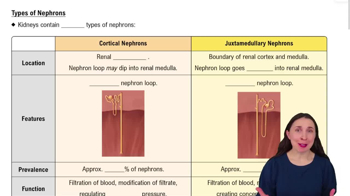
Nephron

The nephron is the functional unit of the kidney, consisting of a renal corpuscle and a renal tubule. It is responsible for the filtration, reabsorption, and secretion processes that regulate the composition of blood and the formation of urine. Urea recycling occurs primarily in the nephron, particularly in the loop of Henle and collecting ducts, where urea can be reabsorbed back into the bloodstream.
Recommended video:
2:30
Types of Nephrons

Renal Pelvis

The renal pelvis is the funnel-shaped structure that collects urine from the nephrons and channels it into the ureter. It serves as a reservoir for urine before it is transported to the bladder. Understanding the role of the renal pelvis is important for tracing the final destination of urea after it has been processed and potentially recycled within the kidney.
Recommended video:
4:58
Overview of Renal Physiology