Ch. 24 The Urinary System
Amerman - Human Anatomy & Physiology 2nd Edition
Amerman2nd EditionHuman Anatomy & PhysiologyISBN: 9780136873822Not the one you use?Change textbook
Chapter 24, Problem L3.B2

What might it mean if you found a high concentration of urobilinogen in your patient's urine? (Hint: Consider the source of urobilinogen.)

Verified step by step guidance
1
Understand the source of urobilinogen: Urobilinogen is a byproduct of bilirubin metabolism. Bilirubin is formed from the breakdown of hemoglobin in red blood cells and is processed in the liver. Some bilirubin is converted into urobilinogen by bacteria in the intestines, and a portion of this urobilinogen is reabsorbed into the bloodstream and excreted in urine.
Consider the normal levels of urobilinogen: Normally, a small amount of urobilinogen is present in urine. Elevated levels may indicate an abnormality in the liver, red blood cell breakdown, or bile flow.
Evaluate potential causes of high urobilinogen: High concentrations of urobilinogen in urine can be associated with conditions such as hemolytic anemia (increased breakdown of red blood cells), liver diseases (e.g., hepatitis or cirrhosis), or excessive bilirubin production.
Connect the findings to liver function: If the liver is unable to process bilirubin effectively due to damage or disease, more bilirubin may be converted into urobilinogen, leading to higher levels in the urine.
Assess the clinical context: To interpret the significance of high urobilinogen, consider other symptoms, lab results (e.g., liver function tests), and the patient’s medical history. This will help determine whether the cause is related to liver dysfunction, hemolysis, or another underlying condition.

Verified video answer for a similar problem:

This video solution was recommended by our tutors as helpful for the problem above.
Was this helpful?

Key Concepts

Here are the essential concepts you must grasp in order to answer the question correctly.

Urobilinogen

Urobilinogen is a colorless byproduct formed from the breakdown of bilirubin in the intestines. It is produced by the action of intestinal bacteria on bilirubin, which is derived from the degradation of hemoglobin in red blood cells. Urobilinogen is normally present in urine in small amounts, and its concentration can provide insights into liver function and hemolysis.

Liver Function

The liver plays a crucial role in metabolizing substances, producing bile, and filtering blood. It is responsible for converting bilirubin into urobilinogen. A high concentration of urobilinogen in urine may indicate liver dysfunction, such as hepatitis or cirrhosis, or increased hemolysis, where red blood cells are broken down excessively, leading to more bilirubin being processed.
Recommended video:
Guided course
2:59
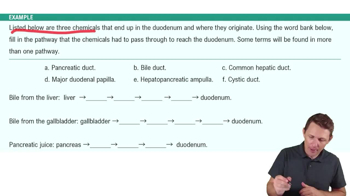
Duct System of the Liver, Gallbladder, and Pancreas Example 1

Hemolysis

Hemolysis is the process of breaking down red blood cells, which releases hemoglobin into the bloodstream. This can lead to increased levels of bilirubin, which the liver then converts to urobilinogen. Conditions such as hemolytic anemia or certain infections can cause excessive hemolysis, resulting in elevated urobilinogen levels in urine, indicating potential underlying health issues.
Related Practice
Textbook Question

Why must the kidneys establish a concentration gradient in the interstitial fluid of the renal medulla in order to produce concentrated urine?

2
views

Textbook Question

Predict the effects the following scenarios would have on glomerular filtration:

c. Having high arterial blood pressure (hypertension)

1
views
Textbook Question

Mr. Wu is a patient with kidney disease who presents to your clinic for monitoring. You notice on his chart that his GFR was estimated through inulin administration to be about 35 ml/min. What does this tell you about the health of his kidneys? Mr. Wu is taking a medication that is normally excreted from the body in the urine. You order blood work and find that the concentration of this medication in his plasma is much higher than normal. How does his decreased GFR explain the elevated level of medication in his plasma?

7
views
Textbook Question

Drugs that treat hypertension, or high blood pressure, have the following actions. Discuss the specific effect that each drug will have on the kidneys.

c. Blocking the Na+/Cl−/2K+ transport pumps in the thick ascending limb of the nephron loop

2
views
Textbook Question

Drugs that treat hypertension, or high blood pressure, have the following actions. Discuss the specific effect that each drug will have on the kidneys.

a. Blocking the action of aldosterone on the kidneys

1
views
Textbook Question

Trace the pathway taken by a molecule of urea through the kidney from the glomerulus to the renal pelvis if the urea is recycled.

2
views