Ch. R - Algebra Review
Lial - Trigonometry 12th Edition
Lial12th EditionTrigonometryISBN: 9780136552161Not the one you use?Change textbook
Chapter 1, Problem 87

Use an inequality symbol to write each statement. 5 + 0 is not equal to 0.

Verified step by step guidance
1
Identify the two expressions being compared: the left side is \(5 + 0\) and the right side is \(0\).
Calculate the value of the left side: \(5 + 0 = 5\).
Recognize that the problem states "is not equal to," which corresponds to the inequality symbol \(\neq\).
Write the inequality using the expressions and the symbol: \(5 + 0 \neq 0\).
This inequality shows that the sum of 5 and 0 is not equal to 0, which matches the given statement.

Verified video answer for a similar problem:

This video solution was recommended by our tutors as helpful for the problem above.
Video duration:
44s
Was this helpful?

Key Concepts

Here are the essential concepts you must grasp in order to answer the question correctly.

Inequality Symbols

Inequality symbols are used to compare two values and show their relationship. Common symbols include < (less than), > (greater than), ≤ (less than or equal to), ≥ (greater than or equal to), and ≠ (not equal to). In this question, the symbol ≠ is used to indicate that two values are not equal.
Recommended video:
5:10
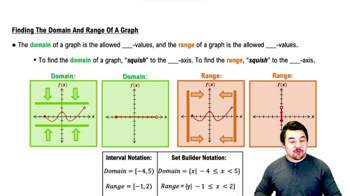
Finding the Domain and Range of a Graph

Evaluating Expressions

Evaluating expressions involves performing arithmetic operations to simplify or find the value of an expression. Here, 5 + 0 simplifies to 5, which helps in comparing it to 0 to determine the correct inequality symbol.
Recommended video:
3:48
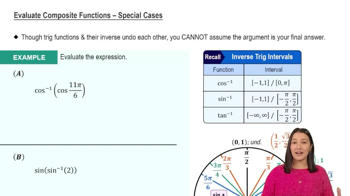
Evaluate Composite Functions - Special Cases

Writing Mathematical Statements

Writing mathematical statements requires translating verbal descriptions into symbolic form. The phrase 'is not equal to' corresponds to the inequality symbol ≠, which is used to express that two quantities differ.
Recommended video:
06:03
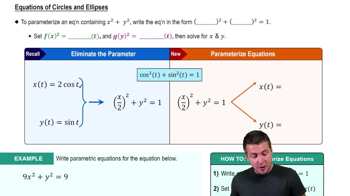
Equations of Circles & Ellipses