Ch. R - Algebra Review
Lial - Trigonometry 12th Edition
Lial12th EditionTrigonometryISBN: 9780136552161Not the one you use?Change textbook
Chapter 1, Problem 89

Simplify each inequality if needed. Then determine whether the statement is true or false. 0 ≤ -5

Verified step by step guidance
1
First, understand the inequality given: \(0 \leq -5\) means "0 is less than or equal to -5."
Recall the number line order: numbers increase as you move to the right. Zero is to the right of -5, so 0 is greater than -5.
Since 0 is greater than -5, the statement \(0 \leq -5\) is not true.
Therefore, the inequality cannot be simplified further because it is already in its simplest form.
Conclude that the statement \(0 \leq -5\) is false.

Verified video answer for a similar problem:

This video solution was recommended by our tutors as helpful for the problem above.
Video duration:
1m
Was this helpful?

Key Concepts

Here are the essential concepts you must grasp in order to answer the question correctly.

Understanding Inequalities

Inequalities compare two values or expressions, indicating if one is less than, greater than, or equal to the other. They can be simplified or manipulated similarly to equations, but special care is needed when multiplying or dividing by negative numbers, as this reverses the inequality sign.
Recommended video:
5:10
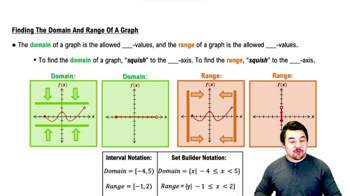
Finding the Domain and Range of a Graph

Evaluating Inequality Statements

To determine if an inequality is true or false, substitute or analyze the values on both sides. For example, checking if 0 ≤ -5 involves comparing zero and negative five directly, understanding their positions on the number line.
Recommended video:
7:28
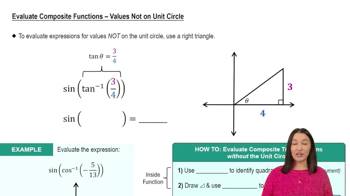
Evaluate Composite Functions - Values Not on Unit Circle

Number Line and Order of Real Numbers

The number line visually represents real numbers in increasing order from left to right. Knowing that zero is greater than any negative number helps quickly assess inequalities like 0 ≤ -5, since zero lies to the right of -5, making the statement false.
Recommended video:
3:31
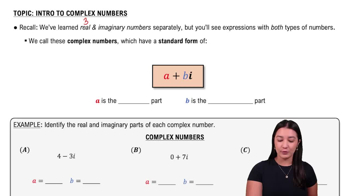
Introduction to Complex Numbers