Ch. 7 - Applications of Trigonometry and Vectors
Lial - Trigonometry 12th Edition
Lial12th EditionTrigonometryISBN: 9780136552161Not the one you use?Change textbook
Chapter 8, Problem 31c

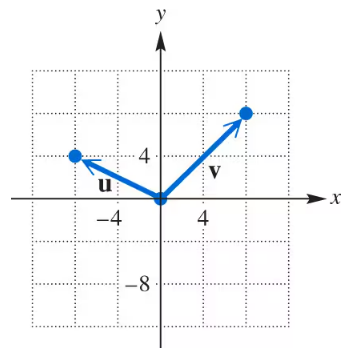
Use the figure to find each vector: - u. Use vector notation as in Example 4.


Verified step by step guidance
1
Identify the vector \( \mathbf{u} \) from the figure, noting its direction and magnitude or its components if given.
Recall that the vector \( -\mathbf{u} \) is the vector \( \mathbf{u} \) reversed in direction but with the same magnitude.
If \( \mathbf{u} \) is given in component form as \( \mathbf{u} = \langle x, y \rangle \), then \( -\mathbf{u} = \langle -x, -y \rangle \).
If the vector \( \mathbf{u} \) is given graphically, determine its components by measuring or using trigonometric relationships based on the angle and length.
Write the vector \( -\mathbf{u} \) explicitly in vector notation, ensuring the direction is opposite to \( \mathbf{u} \) and the magnitude remains the same.

Verified video answer for a similar problem:

This video solution was recommended by our tutors as helpful for the problem above.
Was this helpful?

Key Concepts

Here are the essential concepts you must grasp in order to answer the question correctly.

Vector Notation

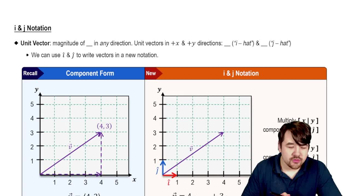
Vector notation represents vectors using components along coordinate axes, typically written as ⟨x, y⟩ in two dimensions. This notation simplifies vector operations like addition, subtraction, and scalar multiplication by expressing vectors as ordered pairs or triples.
Recommended video:
06:01
i & j Notation

Vector Direction and Magnitude

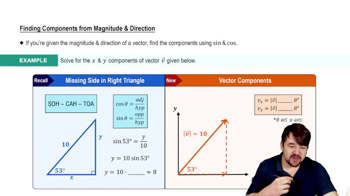
A vector has both magnitude (length) and direction. Understanding how to determine these from a figure is essential, as the vector's components correspond to its horizontal and vertical displacements, which define its direction and size.
Recommended video:
04:55
Finding Components from Direction and Magnitude

Vector Operations (Negation)

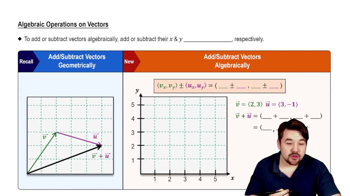
Negating a vector reverses its direction while keeping its magnitude the same. If vector u = ⟨x, y⟩, then -u = ⟨-x, -y⟩. This concept is crucial when the question asks for -u, indicating the vector pointing opposite to u.
Recommended video:
04:12
Algebraic Operations on Vectors