Ch. 7 - Applications of Trigonometry and Vectors
Lial - Trigonometry 12th Edition
Lial12th EditionTrigonometryISBN: 9780136552161Not the one you use?Change textbook
Chapter 8, Problem 31

Apply the law of sines to the following: a = √5, c = 2√5, A = 30°. What is the value of sin C? What is the measure of C? Based on its angle measures, what kind of triangle is triangle ABC?

Verified step by step guidance
1
Identify the known values: side \(a = \sqrt{5}\), side \(c = 2\sqrt{5}\), and angle \(A = 30^\circ\). We want to find \(\sin C\) and the measure of angle \(C\).
Recall the Law of Sines formula: \(\frac{a}{\sin A} = \frac{c}{\sin C}\). This relates the sides and their opposite angles in any triangle.
Substitute the known values into the Law of Sines: \(\frac{\sqrt{5}}{\sin 30^\circ} = \frac{2\sqrt{5}}{\sin C}\).
Solve for \(\sin C\) by cross-multiplying and isolating \(\sin C\): \(\sin C = \frac{2\sqrt{5} \times \sin 30^\circ}{\sqrt{5}}\).
Once you find \(\sin C\), use the inverse sine function to determine angle \(C\): \(C = \sin^{-1}(\sin C)\). Then, analyze the angle measures to classify triangle \(ABC\) as acute, right, or obtuse based on the values of \(A\) and \(C\).

Verified video answer for a similar problem:

This video solution was recommended by our tutors as helpful for the problem above.
Was this helpful?

Key Concepts

Here are the essential concepts you must grasp in order to answer the question correctly.

Law of Sines

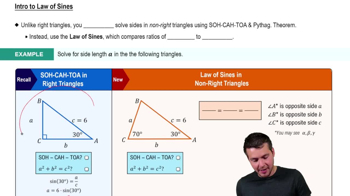
The Law of Sines relates the sides and angles of a triangle by stating that the ratio of a side length to the sine of its opposite angle is constant for all three sides. It is expressed as (a/sin A) = (b/sin B) = (c/sin C). This law is useful for finding unknown sides or angles in non-right triangles.
Recommended video:
4:27
Intro to Law of Sines

Sine Function and Angle Calculation

The sine function relates an angle in a triangle to the ratio of the length of the opposite side over the hypotenuse in right triangles, and is used in the Law of Sines for any triangle. Calculating sin C involves using known sides and angles, and finding angle C requires taking the inverse sine (arcsin) of the ratio obtained.
Recommended video:
5:33
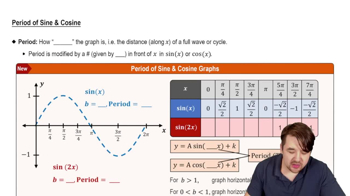
Period of Sine and Cosine Functions

Classification of Triangles by Angles

Triangles are classified based on their angle measures: acute (all angles less than 90°), right (one angle exactly 90°), or obtuse (one angle greater than 90°). After finding angle C, the sum of angles A, B, and C helps determine the triangle type by comparing the measures to these categories.
Recommended video:
5:35
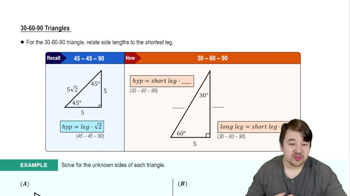
30-60-90 Triangles