A plane flies 650 mph on a bearing of 175.3°. A 25-mph wind, from a direction of 266.6°, blows against the plane. Find the resulting bearing of the plane.

Ch. 7 - Applications of Trigonometry and Vectors
Chapter 8, Problem 51
Find the force required to keep a 75-lb sled from sliding down an incline that makes an angle of 27° with the horizontal. (Assume there is no friction.)
Verified step by step guidance1
Identify the forces acting on the sled: the weight (gravity) acting vertically downward and the force required to keep the sled from sliding down the incline, which acts parallel to the incline surface.
Resolve the weight of the sled into two components: one perpendicular to the incline and one parallel to the incline. The component parallel to the incline causes the sled to slide down.
Use the formula for the component of weight parallel to the incline: \(W_{\parallel} = W \times \sin(\theta)\), where \(W\) is the weight (75 lb) and \(\theta\) is the angle of the incline (27°).
Since there is no friction, the force required to keep the sled from sliding is equal in magnitude and opposite in direction to the parallel component of the weight, so \(F = W_{\parallel}\).
Substitute the known values into the equation \(F = 75 \times \sin(27^\circ)\) to express the force required to keep the sled stationary on the incline.

Verified video answer for a similar problem:
This video solution was recommended by our tutors as helpful for the problem above.
Was this helpful?
Key Concepts
Here are the essential concepts you must grasp in order to answer the question correctly.
Resolving Forces on an Inclined Plane
When an object rests on an inclined plane, its weight can be resolved into two components: one perpendicular to the plane and one parallel to it. The parallel component causes the object to slide down, calculated as weight multiplied by the sine of the incline angle.
Recommended video:
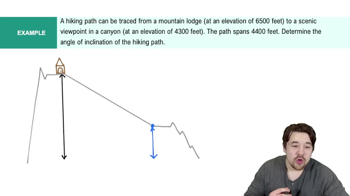
Example 2
Force Required to Prevent Sliding
To keep the sled from sliding, an external force must counteract the component of weight pulling it down the slope. This force equals the parallel component of the weight, acting up the incline to maintain equilibrium.
Recommended video:
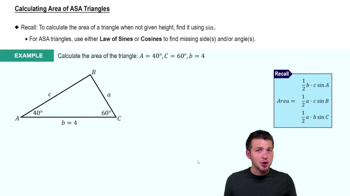
Calculating Area of ASA Triangles
Trigonometric Functions in Force Analysis
Trigonometric functions like sine and cosine relate the angle of the incline to the components of forces. Specifically, sine is used to find the component of weight parallel to the incline, essential for calculating the force needed to prevent sliding.
Recommended video:
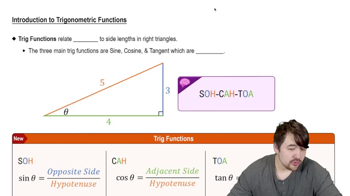
Introduction to Trigonometric Functions
Related Practice
Textbook Question
Textbook Question
Find the dot product for each pair of vectors.
4i, 5i - 9j
Textbook Question
A plane has an airspeed of 520 mph. The pilot wishes to fly on a bearing of 310°. A wind of 37 mph is blowing from a bearing of 212°. In what direction should the pilot fly, and what will be her ground speed?
Textbook Question
Find the area of each triangle ABC.
B = 124.5°, a = 30.4 cm, c = 28.4 cm
Textbook Question
Solve each problem. See Examples 5 and 6.
Bearing and Ground Speed of a Plane An airline route from San Francisco to Honolulu is on a bearing of 233.0°. A jet flying at 450 mph on that bearing encounters a wind blowing at 39.0 mph from a direction of 114.0°. Find the resulting bearing and ground speed of the plane.
8
views
Textbook Question
Find the area of each triangle ABC.
A = 42.5°, b = 13.6 m, c = 10.1 m