A plane flies 650 mph on a bearing of 175.3°. A 25-mph wind, from a direction of 266.6°, blows against the plane. Find the resulting bearing of the plane.
Ch. 7 - Applications of Trigonometry and Vectors
Chapter 8, Problem 53
Find the area of each triangle ABC.
B = 124.5°, a = 30.4 cm, c = 28.4 cm
Verified step by step guidance1
Identify the given elements: angle \(B = 124.5^\circ\), side \(a = 30.4\) cm (opposite angle \(A\)), and side \(c = 28.4\) cm (opposite angle \(C\)). We need to find the area of triangle \(ABC\).
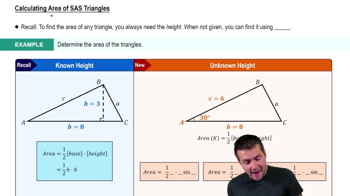
Recall the formula for the area of a triangle using two sides and the included angle: \(\text{Area} = \frac{1}{2} \times b \times c \times \sin A\), where \(b\) and \(c\) are sides enclosing angle \(A\). Since we have angle \(B\), we can use the formula \(\text{Area} = \frac{1}{2} \times a \times c \times \sin B\) because sides \(a\) and \(c\) enclose angle \(B\).
Substitute the known values into the area formula: \(\text{Area} = \frac{1}{2} \times 30.4 \times 28.4 \times \sin 124.5^\circ\).
Calculate \(\sin 124.5^\circ\) using a calculator or trigonometric tables to find the sine of the given angle.
Multiply the values together: half of the product of sides \(a\) and \(c\), and the sine of angle \(B\) to find the area of triangle \(ABC\).

Verified video answer for a similar problem:
This video solution was recommended by our tutors as helpful for the problem above.
Was this helpful?
Key Concepts
Here are the essential concepts you must grasp in order to answer the question correctly.
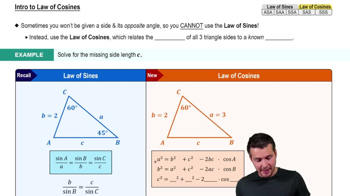
Law of Cosines
The Law of Cosines relates the lengths of the sides of a triangle to the cosine of one of its angles. It is useful for finding an unknown side or angle when two sides and the included angle are known. The formula is c² = a² + b² - 2ab cos(C), which helps in determining missing elements in oblique triangles.
Recommended video:
Intro to Law of Cosines
Area of a Triangle Using Two Sides and Included Angle
The area of a triangle can be calculated using two sides and the included angle with the formula: Area = 1/2 * a * c * sin(B). This method is especially useful when the height is unknown but two sides and the included angle are given, allowing direct computation of the area.
Recommended video:
Calculating Area of SAS Triangles
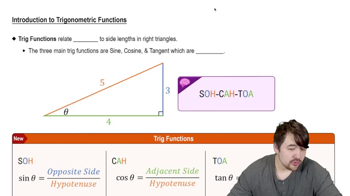
Trigonometric Functions and Angle Measurement
Understanding sine and cosine functions and how to apply them to angles measured in degrees is essential. The sine of an angle in a triangle relates to the ratio of the opposite side to the hypotenuse, and accurate angle measurement ensures correct use of trigonometric formulas in solving triangle problems.
Recommended video:
Introduction to Trigonometric Functions
Related Practice
Textbook Question
Textbook Question
Find the dot product for each pair of vectors.
4i, 5i - 9j
Textbook Question
Find the angle between each pair of vectors. Round to two decimal places as necessary.
〈2, 1〉, 〈-3, 1〉
Textbook Question
Solve each problem. See Examples 5 and 6.
Bearing and Ground Speed of a Plane An airline route from San Francisco to Honolulu is on a bearing of 233.0°. A jet flying at 450 mph on that bearing encounters a wind blowing at 39.0 mph from a direction of 114.0°. Find the resulting bearing and ground speed of the plane.
8
views
Textbook Question
Find the force required to keep a 75-lb sled from sliding down an incline that makes an angle of 27° with the horizontal. (Assume there is no friction.)
Textbook Question
Find the area of each triangle ABC.
A = 42.5°, b = 13.6 m, c = 10.1 m