Ch. 6 - Inverse Circular Functions and Trigonometric Equations
Lial - Trigonometry 12th Edition
Lial12th EditionTrigonometryISBN: 9780136552161Not the one you use?Change textbook
Chapter 7, Problem 4

Use the unit circle shown here to solve each simple trigonometric equation. If the variable is x, then solve over [0, 2π). If the variable is θ, then solve over [0°, 360°).                     
<IMAGE>
sin x = ―√3/2

Verified step by step guidance
1
Identify the trigonometric function and the given value: here, we have \( \sin x = -\frac{\sqrt{3}}{2} \).
Recall the unit circle values where \( \sin \theta = \pm \frac{\sqrt{3}}{2} \). The positive value \( \frac{\sqrt{3}}{2} \) corresponds to angles \( \frac{\pi}{3} \) and \( \frac{2\pi}{3} \), so the negative value will correspond to angles in the third and fourth quadrants.
Determine the reference angle: since \( \sin x = -\frac{\sqrt{3}}{2} \), the reference angle is \( \frac{\pi}{3} \).
Find the angles in the interval \( [0, 2\pi) \) where sine is negative with the reference angle \( \frac{\pi}{3} \). These are \( \pi + \frac{\pi}{3} \) and \( 2\pi - \frac{\pi}{3} \).
Write the solutions explicitly as \( x = \frac{4\pi}{3} \) and \( x = \frac{5\pi}{3} \), which are the values of \( x \) in the interval \( [0, 2\pi) \) satisfying the equation.

Verified video answer for a similar problem:

This video solution was recommended by our tutors as helpful for the problem above.
Was this helpful?

Key Concepts

Here are the essential concepts you must grasp in order to answer the question correctly.

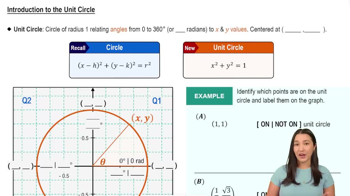
Unit Circle and Angle Measurement

The unit circle is a circle with radius 1 centered at the origin of the coordinate plane. Angles on the unit circle are measured in radians (0 to 2π) or degrees (0° to 360°), and each angle corresponds to a point on the circle whose coordinates represent cosine and sine values. Understanding this helps identify angles where sine or cosine take specific values.
Recommended video:
06:11
Introduction to the Unit Circle

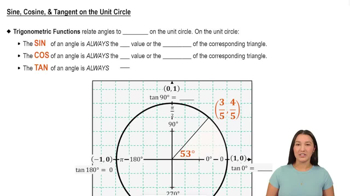
Sine Function and Its Values on the Unit Circle

The sine of an angle corresponds to the y-coordinate of the point on the unit circle at that angle. Knowing the common sine values, such as ±√3/2, and their corresponding angles allows solving equations like sin x = -√3/2 by finding all angles in the given interval with that sine value.
Recommended video:
6:34
Sine, Cosine, & Tangent on the Unit Circle

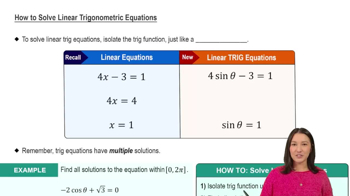
Solving Trigonometric Equations Over a Specified Interval

When solving trigonometric equations, it is essential to find all solutions within the given domain, such as [0, 2π) for radians or [0°, 360°) for degrees. This involves identifying all angles where the trigonometric function equals the given value, considering the function’s periodicity and symmetry on the unit circle.
Recommended video:
4:34
How to Solve Linear Trigonometric Equations