Ch. 6 - Inverse Circular Functions and Trigonometric Equations
Lial - Trigonometry 12th Edition
Lial12th EditionTrigonometryISBN: 9780136552161Not the one you use?Change textbook
Chapter 7, Problem 5

Find the exact value of each real number y. Do not use a calculator.
y = sin⁻¹ √2/2

Verified step by step guidance
1
Recognize that the problem asks for the exact value of \(y = \sin^{-1} \left( \frac{\sqrt{2}}{2} \right)\), which means we need to find the angle \(y\) whose sine is \(\frac{\sqrt{2}}{2}\).
Recall the range of the inverse sine function \(\sin^{-1} x\), which is \([-\frac{\pi}{2}, \frac{\pi}{2}]\). This means the angle \(y\) must lie within this interval.
Identify the common angles where sine values are known exactly. The sine of \(\frac{\pi}{4}\) (or 45 degrees) is \(\frac{\sqrt{2}}{2}\).
Since \(\sin \frac{\pi}{4} = \frac{\sqrt{2}}{2}\) and \(\frac{\pi}{4}\) lies within the range of \(\sin^{-1}\), conclude that \(y = \frac{\pi}{4}\).
Express the final answer as \(y = \frac{\pi}{4}\), which is the exact value of \(\sin^{-1} \left( \frac{\sqrt{2}}{2} \right)\) without using a calculator.

Verified video answer for a similar problem:

This video solution was recommended by our tutors as helpful for the problem above.
Was this helpful?

Key Concepts

Here are the essential concepts you must grasp in order to answer the question correctly.

Inverse Sine Function (sin⁻¹ or arcsin)

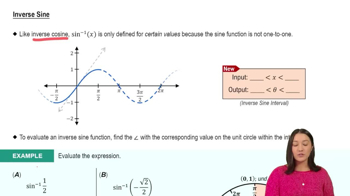
The inverse sine function, sin⁻¹, returns the angle whose sine value is a given number. It is defined for inputs between -1 and 1 and outputs angles in the range [-π/2, π/2]. Understanding this helps find the angle y such that sin(y) = √2/2.
Recommended video:
4:03
Inverse Sine

Exact Values of Sine for Special Angles

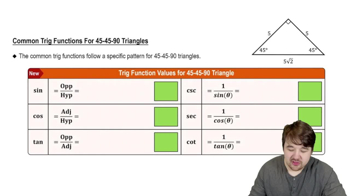
Certain angles have well-known sine values expressed in exact radicals, such as sin(π/4) = √2/2. Recognizing these special angles allows you to determine the exact angle corresponding to a given sine value without a calculator.
Recommended video:
3:28
Common Trig Functions For 45-45-90 Triangles

Domain and Range Restrictions of Inverse Trigonometric Functions

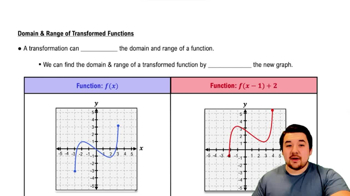
Inverse trig functions have restricted ranges to ensure they are functions. For sin⁻¹, the output angle y must lie between -π/2 and π/2. This restriction ensures a unique solution when finding y = sin⁻¹(√2/2).
Recommended video:
4:22
Domain and Range of Function Transformations