Ch. 6 - Inverse Circular Functions and Trigonometric Equations
Lial - Trigonometry 12th Edition
Lial12th EditionTrigonometryISBN: 9780136552161Not the one you use?Change textbook
Chapter 7, Problem 27

Solve each equation over the interval [0°, 360°). Write solutions as exact values or to the nearest tenth, as appropriate.
(cot θ ―√3) (2 sin θ + √3) = 0

Verified step by step guidance
1
Recognize that the equation is a product of two factors equal to zero: \((\cot \theta - \sqrt{3})(2 \sin \theta + \sqrt{3}) = 0\). According to the zero product property, set each factor equal to zero separately: \(\cot \theta - \sqrt{3} = 0\) and \(2 \sin \theta + \sqrt{3} = 0\).
Solve the first equation \(\cot \theta - \sqrt{3} = 0\) by isolating \(\cot \theta\): \(\cot \theta = \sqrt{3}\). Recall that \(\cot \theta = \frac{\cos \theta}{\sin \theta}\), and find the angles \(\theta\) in \([0^\circ, 360^\circ)\) where this is true.
Solve the second equation \(2 \sin \theta + \sqrt{3} = 0\) by isolating \(\sin \theta\): \(\sin \theta = -\frac{\sqrt{3}}{2}\). Determine the angles \(\theta\) in \([0^\circ, 360^\circ)\) where the sine has this value.
For each equation, use the unit circle or known special angles to find all solutions within the interval \([0^\circ, 360^\circ)\). Remember that \(\cot \theta = \sqrt{3}\) corresponds to angles where tangent is \(\frac{1}{\sqrt{3}}\), and \(\sin \theta = -\frac{\sqrt{3}}{2}\) corresponds to specific reference angles in the third and fourth quadrants.
Combine all solutions from both equations to write the complete solution set for \(\theta\) in the interval \([0^\circ, 360^\circ)\). Express answers as exact values or decimal approximations as appropriate.

Verified video answer for a similar problem:

This video solution was recommended by our tutors as helpful for the problem above.
Was this helpful?

Key Concepts

Here are the essential concepts you must grasp in order to answer the question correctly.

Trigonometric Equations and Zero-Product Property

Solving trigonometric equations often involves factoring expressions and applying the zero-product property, which states that if a product of factors equals zero, at least one factor must be zero. This allows breaking down complex equations into simpler ones to solve individually.
Recommended video:
6:12
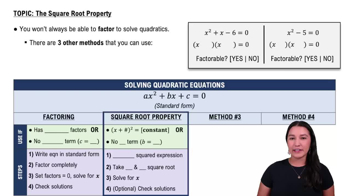
Solving Quadratic Equations by the Square Root Property

Cotangent and Sine Functions

Cotangent (cot θ) is the reciprocal of tangent and can be expressed as cos θ / sin θ. Understanding the behavior and values of cotangent and sine functions within the interval [0°, 360°) is essential for finding exact or approximate solutions to the equation.
Recommended video:
5:37
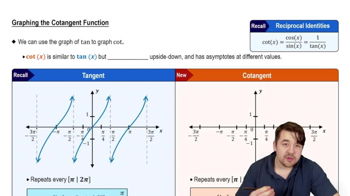
Introduction to Cotangent Graph

Solving Trigonometric Equations on a Specified Interval

When solving trigonometric equations over [0°, 360°), it is important to find all solutions within one full rotation of the unit circle. This involves considering the periodicity of trig functions and identifying all angles that satisfy the equation within the given domain.
Recommended video:
4:34
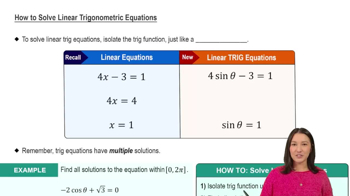
How to Solve Linear Trigonometric Equations