Ch. 6 - Inverse Circular Functions and Trigonometric Equations
Lial - Trigonometry 12th Edition
Lial12th EditionTrigonometryISBN: 9780136552161Not the one you use?Change textbook
Chapter 7, Problem 27

Find the exact value of each real number y if it exists. Do not use a calculator.
y = cot⁻¹ (―1)

Verified step by step guidance
1
Recall that the function \( y = \cot^{-1}(x) \) is the inverse cotangent function, which gives the angle \( y \) whose cotangent is \( x \). So, we want to find \( y \) such that \( \cot y = -1 \).
Remember the definition of cotangent in terms of sine and cosine: \( \cot y = \frac{\cos y}{\sin y} \). We need to find angles where this ratio equals \( -1 \).
Consider the unit circle and the values of sine and cosine where \( \frac{\cos y}{\sin y} = -1 \). This means \( \cos y = -\sin y \). Think about the angles in the interval \( (0, \pi) \) because the principal value range of \( \cot^{-1} \) is usually \( (0, \pi) \).
Set up the equation \( \cos y = -\sin y \) and divide both sides by \( \cos y \) (assuming \( \cos y \neq 0 \)) to get \( 1 = -\tan y \), which simplifies to \( \tan y = -1 \).
Find the angle \( y \) in the interval \( (0, \pi) \) where \( \tan y = -1 \). This angle will be the exact value of \( y = \cot^{-1}(-1) \).

Verified video answer for a similar problem:

This video solution was recommended by our tutors as helpful for the problem above.
Was this helpful?

Key Concepts

Here are the essential concepts you must grasp in order to answer the question correctly.

Inverse Cotangent Function (cot⁻¹)

The inverse cotangent function, cot⁻¹(x), returns the angle whose cotangent is x. It is the inverse of the cotangent function, which relates an angle to the ratio of the adjacent side over the opposite side in a right triangle. Understanding its domain and range is essential for finding exact angle values.
Recommended video:
5:37
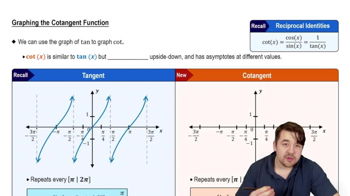
Introduction to Cotangent Graph

Cotangent Function and Its Values

Cotangent of an angle is defined as the ratio of the adjacent side to the opposite side or equivalently as cos(θ)/sin(θ). Knowing common cotangent values, such as cot(π/4) = 1 and cot(3π/4) = -1, helps in identifying angles corresponding to specific cotangent values without a calculator.
Recommended video:
5:37
Introduction to Cotangent Graph

Principal Value Range of cot⁻¹

The principal value of cot⁻¹ is typically taken in the interval (0, π), meaning the output angle y must lie between 0 and π radians. This restriction ensures a unique solution when finding the inverse cotangent, which is crucial for determining the exact value of y when cot⁻¹(-1) is given.
Recommended video:
4:22
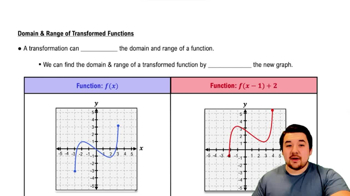
Domain and Range of Function Transformations