
Ch. 2 - Acute Angles and Right Triangles
Lial - Trigonometry 12th Edition
Lial12th EditionTrigonometryISBN: 9780136552161Not the one you use?Change textbook
Chapter 3, Problem 2.5.14

Concept Check The two methods of expressing bearing can be interpreted using a rectangular coordinate system. Suppose that an observer for a radar station is located at the origin of a coordinate system. Find the bearing of an airplane located at each point. Express the bearing using both methods. (0, -2)

Verified step by step guidance
1
Understand that the observer is at the origin (0,0) and the airplane is at the point (0, -2) in the coordinate plane. The bearing is the direction from the observer to the airplane.
Recall that bearings are typically measured clockwise from the north direction (positive y-axis). The first method expresses bearing as an angle clockwise from north, ranging from 0° to 360°.
Determine the angle of the vector from the origin to the point (0, -2). Since the point lies directly on the negative y-axis, the direction is straight south.
Express the bearing in the first method: since the airplane is directly south, the bearing is 180° clockwise from north.
For the second method, bearings are expressed as angles east or west of north or south. Since the airplane is directly south, the bearing is simply S 0° E (or just due south).

Verified video answer for a similar problem:

This video solution was recommended by our tutors as helpful for the problem above.
Video duration:
4m
Was this helpful?

Key Concepts

Here are the essential concepts you must grasp in order to answer the question correctly.

Bearing and Its Methods

Bearing is a way to describe direction relative to a reference, usually north. The two common methods are the compass bearing, measured clockwise from north (0° to 360°), and the quadrant bearing, expressed as an angle east or west of north or south. Understanding both methods allows conversion between them for accurate navigation.
Recommended video:
6:36
Quadratic Formula

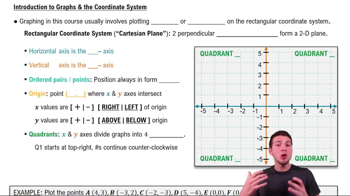
Rectangular Coordinate System and Position Vectors

In a rectangular coordinate system, points are located using (x, y) coordinates relative to the origin. The position vector from the origin to a point can be used to determine direction and distance. This system helps translate spatial locations into angles and bearings by relating coordinates to directions.
Recommended video:
5:10
Introduction to Graphs & the Coordinate System

Calculating Angles Using Inverse Trigonometric Functions

To find the bearing from coordinates, inverse trigonometric functions like arctangent are used to calculate the angle between the position vector and a reference axis. Adjustments are made based on the quadrant to get the correct bearing angle, ensuring the direction is accurately represented relative to north.
Recommended video:
4:45
How to Use a Calculator for Trig Functions