Ch. 5 - Complex Numbers, Polar Coordinates and Parametric Equations
Blitzer - Trigonometry 3rd Edition
Blitzer3rd EditionTrigonometryISBN: 9780137316601Not the one you use?Change textbook
Chapter 5, Problem 11

Find each product and write the result in standard form. (−5 + 4i)(3 + i)

Verified step by step guidance
1
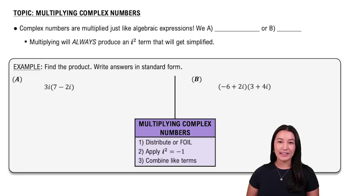
Recall that to multiply two complex numbers in the form \((a + bi)(c + di)\), you use the distributive property (FOIL method): multiply each term in the first complex number by each term in the second complex number.
Apply the distributive property: \((−5 + 4i)(3 + i) = (−5)(3) + (−5)(i) + (4i)(3) + (4i)(i)\).
Calculate each product separately: \((−5)(3) = −15\), \((−5)(i) = −5i\), \((4i)(3) = 12i\), and \((4i)(i) = 4i^2\).
Remember that \(i^2 = -1\), so replace \$4i^2$ with \(4(-1) = -4\).
Combine the real parts and the imaginary parts: real parts are \(-15\) and \(-4\), imaginary parts are \(-5i\) and \$12i\(. Write the final expression in the form \)a + bi$.

Verified video answer for a similar problem:

This video solution was recommended by our tutors as helpful for the problem above.
Video duration:
3m
Was this helpful?

Key Concepts

Here are the essential concepts you must grasp in order to answer the question correctly.

Complex Number Multiplication

Multiplying complex numbers involves using the distributive property (FOIL method) to expand the product of two binomials. Each term is multiplied, remembering that i² = -1, which simplifies the expression into a standard form a + bi.
Recommended video:
5:02
Multiplying Complex Numbers

Standard Form of a Complex Number

The standard form of a complex number is expressed as a + bi, where a is the real part and b is the imaginary coefficient. After multiplication, the result should be simplified and rearranged to clearly separate real and imaginary parts.
Recommended video:
04:47
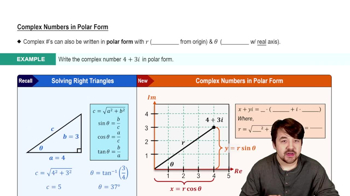
Complex Numbers In Polar Form

Imaginary Unit Properties

The imaginary unit i is defined such that i² = -1. This property is essential when simplifying products involving i, as it converts powers of i into real numbers, allowing the expression to be written in standard form.
Recommended video:
2:20
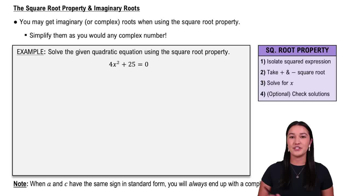
Imaginary Roots with the Square Root Property