Textbook Question
In Exercises 11–14, plot each complex number. Then write the complex number in polar form. You may express the argument in degrees or radians. 1 − i

 Blitzer 3rd EditionCh. 5 - Complex Numbers, Polar Coordinates and Parametric EquationsProblem 11
 Verified step by step guidance
 05:32
05:32
 06:03
06:03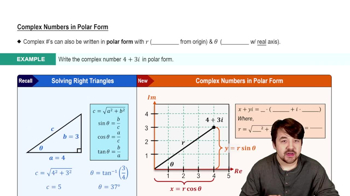 04:47
04:47In Exercises 11–14, plot each complex number. Then write the complex number in polar form. You may express the argument in degrees or radians. 1 − i
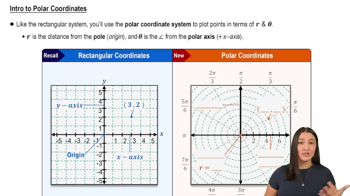
Use a polar coordinate system like the one shown for Exercises 1–10 to plot each point with the given polar coordinates. (2, 45°)
Perform the indicated operations and write the result in standard form. (4 + √−8 )/ 2
Plot each complex number. Then write the complex number in polar form. You may express the argument in degrees or radians. 2 + 2i
Find each product and write the result in standard form. (−5 + 4i)(3 + i)
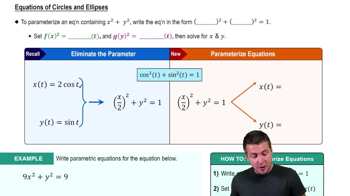
Use point plotting to graph the plane curve described by the given parametric equations. Use arrows to show the orientation of the curve corresponding to increasing values of t. x = t − 2, y = 2t + 1; −2 ≤ t ≤ 3