Ch. 5 - Complex Numbers, Polar Coordinates and Parametric Equations
Blitzer - Trigonometry 3rd Edition
Blitzer3rd EditionTrigonometryISBN: 9780137316601Not the one you use?Change textbook
Chapter 5, Problem 5.2.62

In Exercises 53–64, use DeMoivre's Theorem to find the indicated power of the complex number. Write answers in rectangular form. (1 − i)⁵

Verified step by step guidance
1
Express the complex number \(1 - i\) in polar form. First, find the modulus \(r\) using \(r = \sqrt{a^2 + b^2}\), where \(a = 1\) and \(b = -1\).
Calculate the argument \(\theta\) of the complex number using \(\theta = \tan^{-1}\left(\frac{b}{a}\right)\). Remember to consider the correct quadrant for \(\theta\).
Write the complex number in polar form as \(r(\cos \theta + i \sin \theta)\).
Apply DeMoivre's Theorem to raise the complex number to the 5th power: \(\left[r(\cos \theta + i \sin \theta)\right]^5 = r^5 \left(\cos(5\theta) + i \sin(5\theta)\right)\).
Convert the result back to rectangular form by calculating \(r^5 \cos(5\theta)\) for the real part and \(r^5 \sin(5\theta)\) for the imaginary part.

Verified video answer for a similar problem:

This video solution was recommended by our tutors as helpful for the problem above.
Video duration:
10m
Was this helpful?

Key Concepts

Here are the essential concepts you must grasp in order to answer the question correctly.

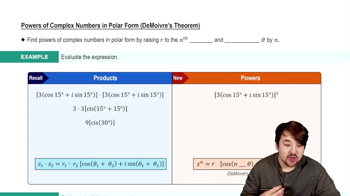
DeMoivre's Theorem

DeMoivre's Theorem states that for a complex number expressed in polar form as r(cos θ + i sin θ), its nth power is r^n (cos nθ + i sin nθ). This theorem simplifies raising complex numbers to powers by working with their magnitude and angle instead of expanding binomials.
Recommended video:
03:41
Powers Of Complex Numbers In Polar Form (DeMoivre's Theorem)

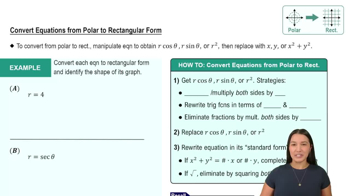
Conversion between Rectangular and Polar Forms

Complex numbers can be represented in rectangular form (a + bi) or polar form (r(cos θ + i sin θ)). Converting to polar form involves finding the magnitude r = √(a² + b²) and the argument θ = arctan(b/a), which is essential for applying DeMoivre's Theorem.
Recommended video:
6:50
Convert Equations from Polar to Rectangular

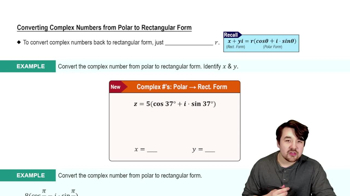
Rectangular Form of Complex Numbers

Rectangular form expresses complex numbers as a + bi, where a is the real part and b is the imaginary part. After using DeMoivre's Theorem in polar form, the result must be converted back to rectangular form by evaluating r^n cos nθ and r^n sin nθ to find the real and imaginary components.
Recommended video:
03:58
Converting Complex Numbers from Polar to Rectangular Form