In Exercises 53–64, use DeMoivre's Theorem to find the indicated power of the complex number. Write answers in rectangular form. [4(cos 15° + i sin 15°)]³
Ch. 5 - Complex Numbers, Polar Coordinates and Parametric Equations

All textbooks
Blitzer 3rd Edition
Ch. 5 - Complex Numbers, Polar Coordinates and Parametric Equations
Problem 5.3.47
Blitzer 3rd Edition
Ch. 5 - Complex Numbers, Polar Coordinates and Parametric Equations
Problem 5.3.47Chapter 5, Problem 5.3.47
In Exercises 41–48, the rectangular coordinates of a point are given. Find polar coordinates of each point. Express θ in radians. (5, 0)
Verified step by step guidance1
Recall that to convert rectangular coordinates \((x, y)\) to polar coordinates \((r, \theta)\), we use the formulas: \(r = \sqrt{x^2 + y^2}\) and \(\theta = \arctan\left(\frac{y}{x}\right)\).
Calculate the radius \(r\) by substituting \(x = 5\) and \(y = 0\) into the formula: \(r = \sqrt{5^2 + 0^2}\).
Simplify the expression for \(r\) to find the distance from the origin to the point.
Find the angle \(\theta\) by evaluating \(\arctan\left(\frac{0}{5}\right)\), which gives the angle the point makes with the positive \(x\)-axis.
Consider the quadrant where the point \((5, 0)\) lies to determine the correct value of \(\theta\) in radians, remembering that if \(x > 0\) and \(y = 0\), \(\theta\) is either \(0\) or \(2\pi\).

Verified video answer for a similar problem:
This video solution was recommended by our tutors as helpful for the problem above.
Video duration:
4mWas this helpful?
Key Concepts
Here are the essential concepts you must grasp in order to answer the question correctly.
Rectangular Coordinates
Rectangular coordinates (x, y) represent a point's position on a plane using horizontal and vertical distances from the origin. The x-value indicates horizontal displacement, while the y-value indicates vertical displacement. Understanding these coordinates is essential for converting to polar form.
Recommended video:
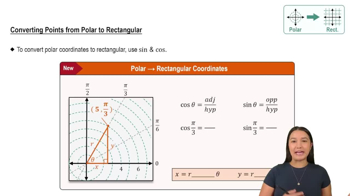
Convert Points from Polar to Rectangular
Polar Coordinates
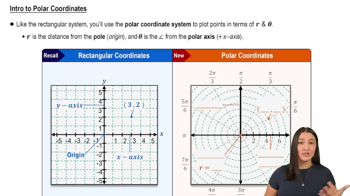
Polar coordinates express a point's location using a distance from the origin (r) and an angle (θ) measured from the positive x-axis. The distance r is always non-negative, and θ is typically given in radians. This system is useful for problems involving rotation or circular motion.
Recommended video:
Intro to Polar Coordinates
Conversion Between Rectangular and Polar Coordinates
To convert from rectangular (x, y) to polar (r, θ), calculate r = √(x² + y²) and θ = arctangent(y/x). Special attention is needed when x = 0 or when determining the correct quadrant for θ. Expressing θ in radians ensures consistency in trigonometric calculations.
Recommended video:
Convert Points from Polar to Rectangular
Related Practice
Textbook Question
3
views
Textbook Question
In Exercises 49–58, convert each rectangular equation to a polar equation that expresses r in terms of θ. x = 7
Textbook Question
In Exercises 49–58, convert each rectangular equation to a polar equation that expresses r in terms of θ.
y² = 6x
1
views
Textbook Question
In Exercises 53–64, use DeMoivre's Theorem to find the indicated power of the complex number. Write answers in rectangular form. (√2 − i)⁴
3
views
Textbook Question
In Exercises 53–64, use DeMoivre's Theorem to find the indicated power of the complex number. Write answers in rectangular form. [√2 (cos (5π/6) + i sin (5π/6))]⁴
1
views
Textbook Question
In Exercises 53–64, use DeMoivre's Theorem to find the indicated power of the complex number. Write answers in rectangular form. (1 − i)⁵