In Exercises 49–58, convert each rectangular equation to a polar equation that expresses r in terms of θ. (x − 2)² + y² = 4
Ch. 5 - Complex Numbers, Polar Coordinates and Parametric Equations

All textbooks
Blitzer 3rd Edition
Ch. 5 - Complex Numbers, Polar Coordinates and Parametric Equations
Problem 4
Blitzer 3rd Edition
Ch. 5 - Complex Numbers, Polar Coordinates and Parametric Equations
Problem 4Chapter 5, Problem 4
In Exercises 1–10, perform the indicated operations and write the result in standard form. (3 − 4i)²
Verified step by step guidance1
Recall that to square a complex number in the form \((a + bi)\), you use the formula \((a + bi)^2 = a^2 + 2abi + (bi)^2\).
Identify the real part \(a = 3\) and the imaginary part \(b = -4\) from the complex number \((3 - 4i)\).
Apply the formula: calculate \(a^2 = 3^2\), \(2ab i = 2 \times 3 \times (-4) i\), and \((bi)^2 = (-4i)^2\) separately.
Remember that \(i^2 = -1\), so simplify \((bi)^2\) accordingly.
Combine the real parts and the imaginary parts to write the result in standard form \(x + yi\).

Verified video answer for a similar problem:
This video solution was recommended by our tutors as helpful for the problem above.
Video duration:
2mWas this helpful?
Key Concepts
Here are the essential concepts you must grasp in order to answer the question correctly.
Complex Numbers and Standard Form
Complex numbers are expressed in the form a + bi, where a is the real part and b is the imaginary part. The standard form refers to writing the result explicitly as a sum of a real number and an imaginary number, making it easier to interpret and use in further calculations.
Recommended video:
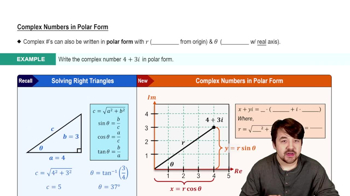
Complex Numbers In Polar Form
Binomial Expansion (Squaring a Complex Number)
Squaring a complex number like (3 − 4i) involves applying the binomial formula (a − b)² = a² − 2ab + b². This requires careful handling of the imaginary unit i, remembering that i² = −1, which affects the sign and value of the terms.
Recommended video:
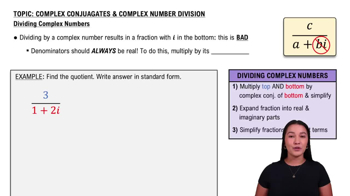
Dividing Complex Numbers
Properties of the Imaginary Unit i
The imaginary unit i is defined such that i² = −1. This property is crucial when simplifying powers of i during operations with complex numbers, as it transforms terms involving i² into real numbers, enabling the expression to be written in standard form.
Recommended video:
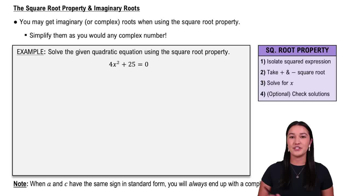
Imaginary Roots with the Square Root Property
Related Practice
Textbook Question
7
views
Textbook Question
In Exercises 1–3, perform the indicated operations and write the result in standard form. ___ ___ 2√−49 + 3√−64
Textbook Question
In Exercises 1–10, indicate if the point with the given polar coordinates is represented by A, B, C, or D on the graph. (−3, 5π/4)
5
views
Textbook Question
In Exercises 1–8, parametric equations and a value for the parameter t are given. Find the coordinates of the point on the plane curve described by the parametric equations corresponding to the given value of t. x = t² + 3, y = 6 − t³; t = 2
2
views
Textbook Question
In Exercises 53–58, perform the indicated operation(s) and write the result in standard form. ___ ___ 5√(−16) + 3√(−81)
Textbook Question
_ Write −√3 + i in polar form.
8
views