In Exercises 1–3, perform the indicated operations and write the result in standard form. ___ ___ 2√−49 + 3√−64
Ch. 5 - Complex Numbers, Polar Coordinates and Parametric Equations

All textbooks
Blitzer 3rd Edition
Ch. 5 - Complex Numbers, Polar Coordinates and Parametric Equations
Problem 3
Blitzer 3rd Edition
Ch. 5 - Complex Numbers, Polar Coordinates and Parametric Equations
Problem 3Chapter 5, Problem 3
In Exercises 1–10, indicate if the point with the given polar coordinates is represented by A, B, C, or D on the graph. (−3, 5π/4)
Verified step by step guidance1
Recall that polar coordinates are given in the form \((r, \theta)\), where \(r\) is the distance from the origin and \(\theta\) is the angle measured counterclockwise from the positive x-axis.
Note that the given point is \((-3, \frac{5\pi}{4})\). Since \(r\) is negative, the point lies in the direction opposite to the angle \(\frac{5\pi}{4}\).
Find the angle directly opposite to \(\frac{5\pi}{4}\) by adding or subtracting \(\pi\) (180 degrees): calculate \(\theta_{opposite} = \frac{5\pi}{4} - \pi = \frac{\pi}{4}\).
Plot the point by moving a distance of \(3\) units (the absolute value of \(r\)) from the origin in the direction of \(\theta_{opposite} = \frac{\pi}{4}\).
Compare this location with points A, B, C, and D on the graph to determine which one corresponds to the coordinates \((-3, \frac{5\pi}{4})\).

Verified video answer for a similar problem:
This video solution was recommended by our tutors as helpful for the problem above.
Video duration:
2mWas this helpful?
Key Concepts
Here are the essential concepts you must grasp in order to answer the question correctly.
Polar Coordinates
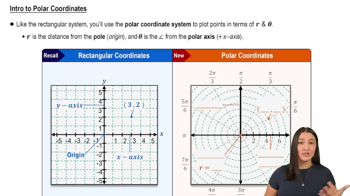
Polar coordinates represent a point in the plane using a distance from the origin (radius) and an angle measured from the positive x-axis. The format is (r, θ), where r is the radius and θ is the angle in radians or degrees.
Recommended video:
Intro to Polar Coordinates
Negative Radius in Polar Coordinates
A negative radius means the point is located in the direction opposite to the angle θ. To plot (−r, θ), you move r units in the direction θ + π (180 degrees), effectively reversing the direction.
Recommended video:
Intro to Polar Coordinates
Angle Measurement in Radians
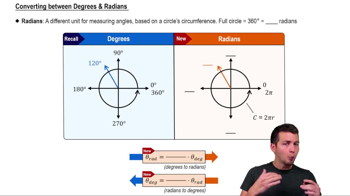
Angles in polar coordinates are often given in radians, where 2π radians equal 360 degrees. Understanding how to convert and interpret angles like 5π/4 helps locate the correct direction on the graph.
Recommended video:
Converting between Degrees & Radians
Related Practice
Textbook Question
Textbook Question
In Exercises 1–8, parametric equations and a value for the parameter t are given. Find the coordinates of the point on the plane curve described by the parametric equations corresponding to the given value of t. x = t² + 1, y = 5 − t³; t = 2
Textbook Question
In Exercises 1–8, parametric equations and a value for the parameter t are given. Find the coordinates of the point on the plane curve described by the parametric equations corresponding to the given value of t. x = t² + 3, y = 6 − t³; t = 2
2
views
Textbook Question
In Exercises 1–8, add or subtract as indicated and write the result in standard form. (3 + 2i) − (5 − 7i)
1
views
Textbook Question
_ Write −√3 + i in polar form.
8
views
Textbook Question
In Exercises 1–10, perform the indicated operations and write the result in standard form. (3 − 4i)²