Ch. 3 - Trigonometric Identities and Equations
Blitzer - Trigonometry 3rd Edition
Blitzer3rd EditionTrigonometryISBN: 9780137316601Not the one you use?Change textbook
Chapter 3, Problem 12

In Exercises 7–14, use the given information to find the exact value of each of the following:c. tan 2θcot θ = 3, θ lies in quadrant III.

Verified step by step guidance
1
insert step 1: Understand that \( \cot \theta = 3 \) implies \( \tan \theta = \frac{1}{3} \) because \( \tan \theta = \frac{1}{\cot \theta} \).
insert step 2: Since \( \theta \) is in quadrant III, both sine and cosine are negative, but tangent is positive.
insert step 3: Use the double angle identity for tangent: \( \tan 2\theta = \frac{2 \tan \theta}{1 - \tan^2 \theta} \).
insert step 4: Substitute \( \tan \theta = \frac{1}{3} \) into the double angle identity: \( \tan 2\theta = \frac{2 \times \frac{1}{3}}{1 - (\frac{1}{3})^2} \).
insert step 5: Simplify the expression to find \( \tan 2\theta \).

Verified video answer for a similar problem:

This video solution was recommended by our tutors as helpful for the problem above.
Video duration:
4m
Was this helpful?

Key Concepts

Here are the essential concepts you must grasp in order to answer the question correctly.

Trigonometric Identities

Trigonometric identities are equations that involve trigonometric functions and are true for all values of the variables involved. One important identity is the double angle formula for tangent, which states that tan(2θ) = 2tan(θ) / (1 - tan²(θ)). Understanding these identities is crucial for simplifying and solving trigonometric expressions.
Recommended video:
5:32
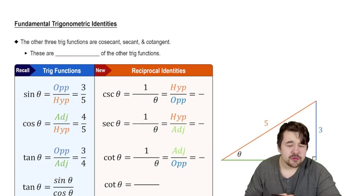
Fundamental Trigonometric Identities

Quadrants and Signs of Trigonometric Functions

The unit circle is divided into four quadrants, each affecting the signs of the trigonometric functions. In quadrant III, both sine and cosine are negative, which means tangent (the ratio of sine to cosine) is positive. Knowing the quadrant in which the angle lies helps determine the signs of the trigonometric values needed for calculations.
Recommended video:
6:36
Quadratic Formula

Finding Trigonometric Values from Cotangent

Cotangent is the reciprocal of tangent, defined as cot(θ) = 1/tan(θ). Given cot(θ) = 3, we can find tan(θ) as 1/3. This relationship allows us to derive other trigonometric values, such as sine and cosine, using the Pythagorean identity, which is essential for calculating tan(2θ) accurately.
Recommended video:
04:55
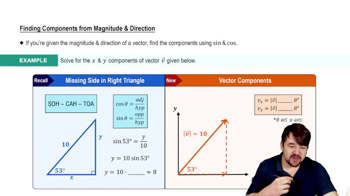
Finding Components from Direction and Magnitude