Ch. 3 - Trigonometric Identities and Equations
Blitzer - Trigonometry 3rd Edition
Blitzer3rd EditionTrigonometryISBN: 9780137316601Not the one you use?Change textbook
Chapter 3, Problem 13

Find all solutions of each equation. tan x = 1

Verified step by step guidance
1
Recall that the equation \( \tan x = 1 \) means we are looking for all angles \( x \) where the tangent function equals 1.
Identify the principal solution by remembering that \( \tan x = 1 \) at \( x = \frac{\pi}{4} \) (or 45 degrees) in the first quadrant.
Since the tangent function has a period of \( \pi \), all solutions can be expressed as \( x = \frac{\pi}{4} + k\pi \), where \( k \) is any integer.
Write the general solution explicitly: \[ x = \frac{\pi}{4} + k\pi, \quad k \in \mathbb{Z} \]
This formula gives all angles \( x \) for which \( \tan x = 1 \), covering all possible solutions.

Verified video answer for a similar problem:

This video solution was recommended by our tutors as helpful for the problem above.
Video duration:
7m
Was this helpful?

Key Concepts

Here are the essential concepts you must grasp in order to answer the question correctly.

Definition and Properties of the Tangent Function

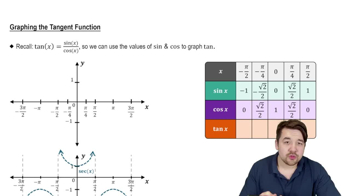
The tangent function, tan(x), is defined as the ratio of sine to cosine: tan(x) = sin(x)/cos(x). It is periodic with period π, meaning tan(x + π) = tan(x). Understanding its behavior and domain restrictions is essential for solving equations involving tan(x).
Recommended video:
5:43
Introduction to Tangent Graph

Solving Basic Trigonometric Equations

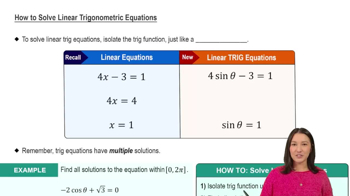
To solve equations like tan(x) = 1, identify the principal angle where the equation holds true, then use the function's periodicity to find all solutions. For tangent, solutions repeat every π radians, so general solutions are expressed as x = θ + nπ, where n is any integer.
Recommended video:
4:34
How to Solve Linear Trigonometric Equations

Reference Angles and Quadrant Analysis

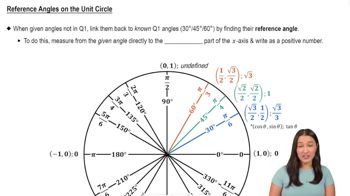
Reference angles help determine the exact solutions of trigonometric equations by relating angles to their acute counterparts. Since tan(x) = 1 at 45° (π/4 radians) and in the third quadrant where tangent is positive, recognizing these quadrants aids in finding all valid solutions.
Recommended video:
5:31
Reference Angles on the Unit Circle