Ch. 2 - Graphs of the Trigonometric Functions; Inverse Trigonometric Functions
Blitzer - Trigonometry 3rd Edition
Blitzer3rd EditionTrigonometryISBN: 9780137316601Not the one you use?Change textbook
Chapter 2, Problem 35

In Exercises 35–42, determine the amplitude and period of each function. Then graph one period of the function. y = cos 2x

Verified step by step guidance
1
Identify the general form of the cosine function: \(y = \cos(Bx)\), where \(B\) affects the period of the function.
Recall that the amplitude of a cosine function \(y = A \cos(Bx)\) is the absolute value of \(A\). In this problem, since the function is \(y = \cos 2x\), the amplitude \(A\) is 1.
Calculate the period of the function using the formula \(\text{Period} = \frac{2\pi}{|B|}\). Here, \(B = 2\), so the period is \(\frac{2\pi}{2} = \pi\).
To graph one period of the function, start by plotting key points over the interval from \(x = 0\) to \(x = \pi\), since this represents one full cycle of the function.
Mark the amplitude on the graph by noting the maximum value at 1 and the minimum value at -1, then sketch the cosine curve starting at \(y=1\) when \(x=0\), going down to \(y=-1\) at \(x=\frac{\pi}{2}\), and returning to \(y=1\) at \(x=\pi\).

Verified video answer for a similar problem:

This video solution was recommended by our tutors as helpful for the problem above.
Video duration:
8m
Was this helpful?

Key Concepts

Here are the essential concepts you must grasp in order to answer the question correctly.

Amplitude of a Trigonometric Function

Amplitude is the maximum absolute value of a trigonometric function from its midline. For functions like y = cos(kx), the amplitude is the coefficient in front of the cosine, indicating the height of peaks and depth of troughs. In y = cos 2x, the amplitude is 1, meaning the graph oscillates between 1 and -1.
Recommended video:
6:04
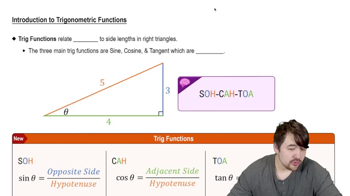
Introduction to Trigonometric Functions

Period of a Trigonometric Function

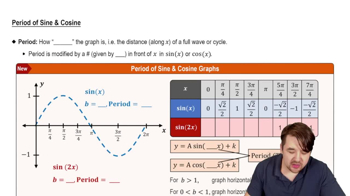
The period is the length of one complete cycle of the function along the x-axis. For y = cos(kx), the period is calculated as (2π) / |k|. In y = cos 2x, the period is π, meaning the cosine wave repeats every π units.
Recommended video:
5:33
Period of Sine and Cosine Functions

Graphing One Period of a Cosine Function

Graphing one period involves plotting the function from 0 to its period, marking key points such as maxima, minima, and zeros. For y = cos 2x, plot from 0 to π, noting that the function starts at 1, crosses zero at π/4 and 3π/4, and reaches -1 at π/2, then returns to 1 at π.
Recommended video:
5:33
Period of Sine and Cosine Functions