In Exercises 35–42, determine the amplitude and period of each function. Then graph one period of the function. y = 4 cos 2πx
Ch. 2 - Graphs of the Trigonometric Functions; Inverse Trigonometric Functions

All textbooks
Blitzer 3rd Edition
Ch. 2 - Graphs of the Trigonometric Functions; Inverse Trigonometric Functions
Problem 37
Blitzer 3rd Edition
Ch. 2 - Graphs of the Trigonometric Functions; Inverse Trigonometric Functions
Problem 37Chapter 2, Problem 37
In Exercises 29–51, find the exact value of each expression. Do not use a calculator. sec⁻¹ (−1)
Verified step by step guidance1
Recall that the function \( \sec^{-1}(x) \) is the inverse secant function, which gives the angle \( \theta \) such that \( \sec(\theta) = x \).
Understand that \( \sec(\theta) = \frac{1}{\cos(\theta)} \), so \( \sec^{-1}(-1) \) means finding \( \theta \) where \( \cos(\theta) = -1 \).
Identify the range of the inverse secant function, which is typically \( [0, \pi] \) excluding \( \frac{\pi}{2} \), to find the principal value of \( \theta \).
Determine the angle \( \theta \) within the range \( [0, \pi] \) where \( \cos(\theta) = -1 \).
Express the exact value of \( \sec^{-1}(-1) \) as the angle \( \theta \) found in the previous step.

Verified video answer for a similar problem:
This video solution was recommended by our tutors as helpful for the problem above.
Video duration:
1mWas this helpful?
Key Concepts
Here are the essential concepts you must grasp in order to answer the question correctly.
Inverse Secant Function (sec⁻¹)
The inverse secant function, sec⁻¹(x), returns the angle whose secant is x. Since secant is the reciprocal of cosine, sec⁻¹(x) = θ means sec(θ) = x, or cos(θ) = 1/x. Understanding the domain and range restrictions of sec⁻¹ is essential to find the correct angle.
Recommended video:
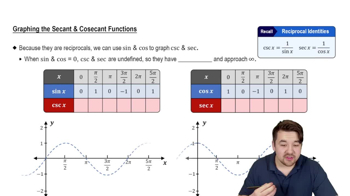
Graphs of Secant and Cosecant Functions
Domain and Range of sec⁻¹
The domain of sec⁻¹(x) is |x| ≥ 1 because secant values are always ≤ -1 or ≥ 1. Its range is typically [0, π] excluding π/2, to ensure the function is one-to-one. Recognizing these restrictions helps identify valid angles for the inverse secant.
Recommended video:
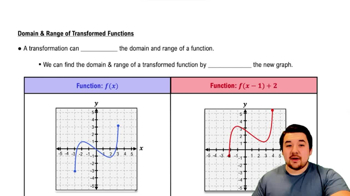
Domain and Range of Function Transformations
Exact Values of Trigonometric Functions
Finding exact values involves using known special angles and their trigonometric values without a calculator. For sec⁻¹(-1), knowing that sec(π) = -1 allows us to determine the exact angle. Familiarity with unit circle values is crucial for this process.
Recommended video:
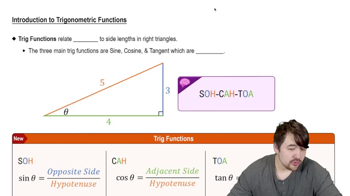
Introduction to Trigonometric Functions
Related Practice
Textbook Question
7
views
Textbook Question
In Exercises 37–40, an object moves in simple harmonic motion described by the given equation, where t is measured in seconds and d in inches. In each exercise, graph one period of the equation. Then find the following: a. the maximum displacement b. the frequency c. the time required for one cycle d. the phase shift of the motion. d = 3 cos(πt + π/2)
10
views
Textbook Question
Graph two periods of the given cosecant or secant function.
y = sec x/2
2
views
Textbook Question
In Exercises 29–44, graph two periods of the given cosecant or secant function. y = −1/2 sec πx
Textbook Question
In Exercises 29–44, graph two periods of the given cosecant or secant function. y = −2 csc πx
1
views
Textbook Question
In Exercises 27–38, use a calculator to find the value of each expression rounded to two decimal places. ___ tan⁻¹ (−√473)
1
views