In Exercises 19–24, a. Use the unit circle shown for Exercises 5–18 to find the value of the trigonometric function.b. Use even and odd properties of trigonometric functions and your answer from part (a) to find the value of the same trigonometric function at the indicated real number.cos 𝜋/3
Verified step by step guidance
1
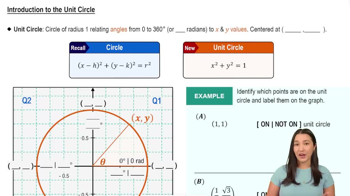
Locate the angle \( \frac{\pi}{3} \) on the unit circle. It corresponds to the point \( \left( \frac{1}{2}, \frac{\sqrt{3}}{2} \right) \).
Identify the cosine value of \( \frac{\pi}{3} \) from the unit circle, which is the x-coordinate of the point, \( \frac{1}{2} \).
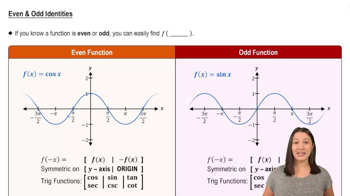
Recall the even property of cosine: \( \cos(-x) = \cos(x) \).
Use the even property to find \( \cos(-\frac{\pi}{3}) \), which is also \( \frac{1}{2} \).
Conclude that the cosine value for both \( \frac{\pi}{3} \) and \( -\frac{\pi}{3} \) is \( \frac{1}{2} \).
Verified video answer for a similar problem:
This video solution was recommended by our tutors as helpful for the problem above.
Video duration:
4m
Play a video:
0 Comments
Was this helpful?
Key Concepts
Here are the essential concepts you must grasp in order to answer the question correctly.
Unit Circle
The unit circle is a circle with a radius of one centered at the origin of a coordinate plane. It is fundamental in trigonometry as it provides a geometric representation of the sine, cosine, and tangent functions. The coordinates of points on the unit circle correspond to the cosine and sine values of angles measured from the positive x-axis, allowing for easy calculation of trigonometric functions.
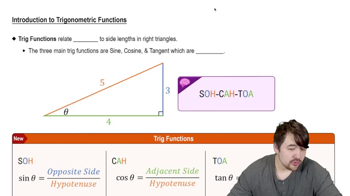
Trigonometric functions, such as sine, cosine, and tangent, relate the angles of a triangle to the lengths of its sides. In the context of the unit circle, the cosine of an angle is the x-coordinate, while the sine is the y-coordinate of the corresponding point on the circle. Understanding these functions is crucial for solving problems involving angles and their relationships in various mathematical contexts.
Trigonometric functions exhibit specific symmetry properties: cosine is an even function, meaning cos(-x) = cos(x), while sine and tangent are odd functions, meaning sin(-x) = -sin(x) and tan(-x) = -tan(x). These properties allow for simplifications when calculating trigonometric values for negative angles or angles greater than π, making it easier to find values using known angles on the unit circle.