Ch. 1 - Angles and the Trigonometric Functions
Blitzer - Trigonometry 3rd Edition
Blitzer3rd EditionTrigonometryISBN: 9780137316601Not the one you use?Change textbook
Chapter 1, Problem 20

In Exercises 17–20, θ is an acute angle and sin θ and cos θ are given. Use identities to find tan θ, csc θ, sec θ, and cot θ. Where necessary, rationalize denominators.__sin θ = 6, cos θ = √137 7

Verified step by step guidance
1
Step 1: Recall the identity for tangent: \( \tan \theta = \frac{\sin \theta}{\cos \theta} \). Substitute the given values: \( \tan \theta = \frac{\frac{6}{7}}{\frac{\sqrt{13}}{7}} \).
Step 2: Simplify the expression for \( \tan \theta \) by multiplying the numerator and the denominator by 7 to eliminate the fraction: \( \tan \theta = \frac{6}{\sqrt{13}} \).
Step 3: Rationalize the denominator of \( \tan \theta \) by multiplying the numerator and the denominator by \( \sqrt{13} \): \( \tan \theta = \frac{6\sqrt{13}}{13} \).
Step 4: Use the reciprocal identities to find \( \csc \theta \) and \( \sec \theta \): \( \csc \theta = \frac{1}{\sin \theta} = \frac{7}{6} \) and \( \sec \theta = \frac{1}{\cos \theta} = \frac{7}{\sqrt{13}} \).
Step 5: Rationalize the denominator for \( \sec \theta \) by multiplying the numerator and the denominator by \( \sqrt{13} \): \( \sec \theta = \frac{7\sqrt{13}}{13} \). Use the reciprocal identity for cotangent: \( \cot \theta = \frac{1}{\tan \theta} = \frac{\sqrt{13}}{6} \).

Verified video answer for a similar problem:

This video solution was recommended by our tutors as helpful for the problem above.
Video duration:
4m
Was this helpful?

Key Concepts

Here are the essential concepts you must grasp in order to answer the question correctly.

Trigonometric Ratios

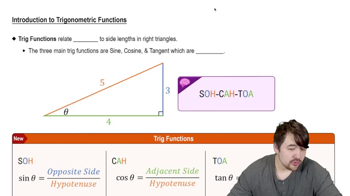
Trigonometric ratios are relationships between the angles and sides of a right triangle. The primary ratios include sine (sin), cosine (cos), and tangent (tan), defined as sin θ = opposite/hypotenuse, cos θ = adjacent/hypotenuse, and tan θ = opposite/adjacent. Understanding these ratios is essential for deriving other trigonometric functions and solving problems involving angles.
Recommended video:
6:04
Introduction to Trigonometric Functions

Reciprocal Identities

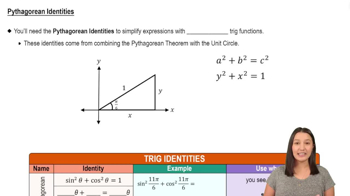
Reciprocal identities relate the primary trigonometric functions to their reciprocals. For example, cosecant (csc) is the reciprocal of sine, secant (sec) is the reciprocal of cosine, and cotangent (cot) is the reciprocal of tangent. These identities are crucial for finding additional trigonometric values when given sin θ and cos θ, as they allow for straightforward calculations.
Recommended video:
6:25
Pythagorean Identities

Rationalizing Denominators

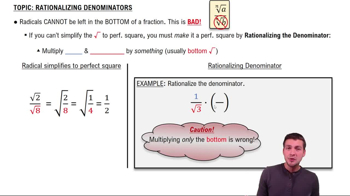
Rationalizing the denominator is a technique used to eliminate radicals from the denominator of a fraction. This is achieved by multiplying the numerator and denominator by a suitable value that will result in a rational number in the denominator. This process is often required in trigonometry to simplify expressions and ensure that the final answers are presented in a standard form.
Recommended video:
2:58
Rationalizing Denominators
Related Practice
Textbook Question
In Exercises 17–20, θ is an acute angle and sin θ and cos θ are given. Use identities to find tan θ, csc θ, sec θ, and cot θ. Where necessary, rationalize denominators.sin θ = 3/5, cos θ = 4/5
1
views
Textbook Question
In Exercises 19–24, a. Use the unit circle shown for Exercises 5–18 to find the value of the trigonometric function.b. Use even and odd properties of trigonometric functions and your answer from part (a) to find the value of the same trigonometric function at the indicated real number.cos (-𝜋/6)

1
views
Textbook Question
In Exercises 21–24, θ is an acute angle and sin θ is given. Use the Pythagorean identity sin²θ + cos²θ = 1 to find cos θ.sin θ = 6/7
1
views
Textbook Question
In Exercises 5–18, the unit circle has been divided into twelve equal arcs, corresponding to t-values of0, 𝜋, 𝜋, 𝜋, 2𝜋, 5𝜋, 𝜋, 7𝜋, 4𝜋, 3𝜋, 5𝜋, 11𝜋, and 2𝜋.6 3 2 3 6 6 3 2 3 6Use the (x,y) coordinates in the figure to find the value of each trigonometric function at the indicated real number, t, or state that the expression is undefined.

In Exercises 11–18, continue to refer to the figure at the bottom of the previous page.tan 3𝜋/2
1
views
Textbook Question
In Exercises 19–24, a. Use the unit circle shown for Exercises 5–18 to find the value of the trigonometric function.b. Use even and odd properties of trigonometric functions and your answer from part (a) to find the value of the same trigonometric function at the indicated real number.cos 𝜋/3

Textbook Question
In Exercises 19–24, a. Use the unit circle shown for Exercises 5–18 to find the value of the trigonometric function.b. Use even and odd properties of trigonometric functions and your answer from part (a) to find the value of the same trigonometric function at the indicated real number.sin 5𝜋/6

1
views