 Back
BackTrigonometry Midterm Study Guidance – Key Problems with Step-by-Step Help
Study Guide - Smart Notes
 Tailored notes based on your materials, expanded with key definitions, examples, and context.
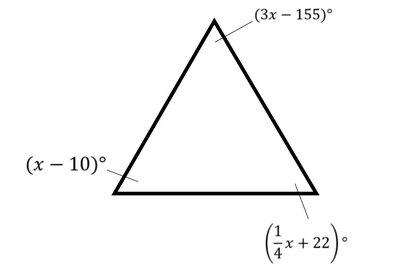
Q2. Find the measure of the indicated angles in the triangle below.
Background
Topic: Triangle Angle Sum Theorem
This question tests your understanding of the sum of the interior angles of a triangle and how to set up and solve equations involving algebraic expressions for unknown angles.
Key Terms and Formulas
Triangle Angle Sum Theorem: The sum of the interior angles in any triangle is always 180°.
Algebraic Expression: Each angle is given as an expression in terms of x.
Step-by-Step Guidance
Write an equation for the sum of the three angles using the given expressions:
Combine like terms for all the x's and constants on the left side of the equation.
Isolate the variable x by moving all terms involving x to one side and constants to the other.
Solve for x by performing the necessary algebraic operations (combine, multiply/divide as needed).
Try solving on your own before revealing the answer!
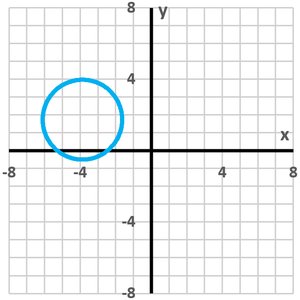
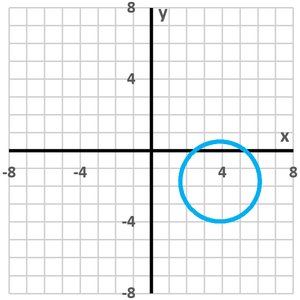
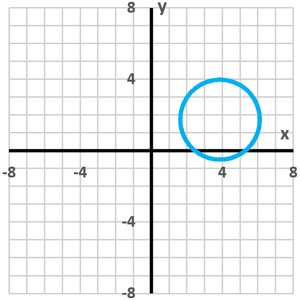
Q3. Find the center-radius form of the equation of the circle using the given information and plot it on the rectangular coordinate system.
Background
Topic: Equation of a Circle in Standard Form
This question tests your ability to write the equation of a circle given its center and radius, and to match it to a graph.
Key Terms and Formulas
Standard Form of a Circle:
Where (h, k) is the center and r is the radius.
Step-by-Step Guidance
Identify the center and radius from the problem statement.
Substitute the values of , , and into the standard form equation.
Simplify the equation as needed (e.g., square the radius if necessary).
Compare your equation to the given answer choices and match it to the correct graph.
Try solving on your own before revealing the answer!
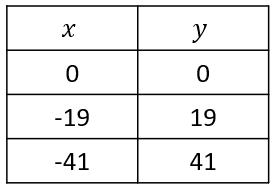
Q4. Identify if the given relation represents a function. Then, determine its domain and range.
Background
Topic: Functions, Domain, and Range
This question tests your understanding of what makes a relation a function, and how to identify the domain and range from a set of ordered pairs or a table.
Key Terms and Formulas
Function: A relation where each input (x-value) has exactly one output (y-value).
Domain: The set of all possible input values (x-values).
Range: The set of all possible output values (y-values).
Step-by-Step Guidance
Check if each x-value in the table is paired with only one y-value (no x-value repeats with a different y-value).
List all the x-values to determine the domain.
List all the y-values to determine the range.
Decide if the relation is a function based on your findings.
Try solving on your own before revealing the answer!
