Join thousands of students who trust us to help them ace their exams!
Multiple Choice
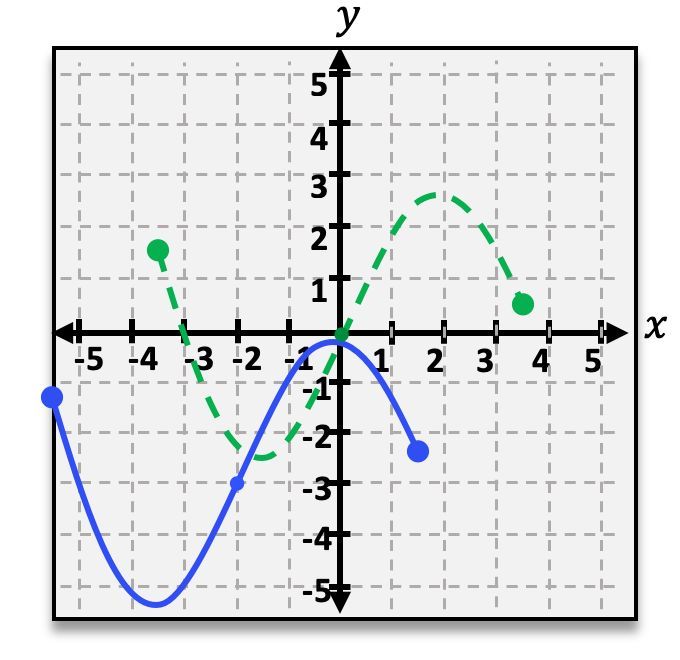
The green dotted line in the graph below represents the function f(x). The blue solid line represents the function g(x), which is the function f(x)after it has gone through a shift transformation. Find the equation for g(x).
A
g(x)=f(x−2)+3
B
g(x)=f(x−2)−3
C
g(x)=f(x+2)−3
D
g(x)=f(x)−3
0 Comments
Verified step by step guidance
1
Identify the transformation from the graph: The green dotted line is the original function f(x), and the blue solid line is the transformed function g(x).
Observe the horizontal shift: The green function f(x) is shifted to the left to become the blue function g(x). This indicates a horizontal shift to the left by 2 units.
Observe the vertical shift: The green function f(x) is shifted downwards to become the blue function g(x). This indicates a vertical shift down by 3 units.
Combine the transformations: A horizontal shift to the left by 2 units is represented by f(x + 2), and a vertical shift down by 3 units is represented by subtracting 3.
Write the equation for g(x): Combine the horizontal and vertical shifts to get g(x) = f(x + 2) - 3.


 Verified step by step guidance