Ch. 4 - Laws of Sines and Cosines; Vectors
Blitzer - Trigonometry 3rd Edition
Blitzer3rd EditionTrigonometryISBN: 9780137316601Not the one you use?Change textbook
Chapter 4, Problem 1

Use the following conditions to solve Exercises 1–4:4 𝝅sin α = ----- , ------- < α < 𝝅5 25 𝝅cos β = ------ , 0 < β < ------13 2Find the exact value of each of the following.cos (α + β)

Verified step by step guidance
1
Identify the formula for the cosine of the sum of two angles: \( \cos(\alpha + \beta) = \cos \alpha \cos \beta - \sin \alpha \sin \beta \).
Determine \( \cos \alpha \) using the Pythagorean identity: \( \sin^2 \alpha + \cos^2 \alpha = 1 \). Since \( \sin \alpha = \frac{4\pi}{5} \), calculate \( \cos \alpha \).
Determine \( \sin \beta \) using the Pythagorean identity: \( \sin^2 \beta + \cos^2 \beta = 1 \). Since \( \cos \beta = \frac{5\pi}{13} \), calculate \( \sin \beta \).
Substitute the values of \( \cos \alpha \), \( \cos \beta \), \( \sin \alpha \), and \( \sin \beta \) into the formula for \( \cos(\alpha + \beta) \).
Simplify the expression to find the exact value of \( \cos(\alpha + \beta) \).

Verified video answer for a similar problem:

This video solution was recommended by our tutors as helpful for the problem above.
Video duration:
7m
Was this helpful?

Key Concepts

Here are the essential concepts you must grasp in order to answer the question correctly.

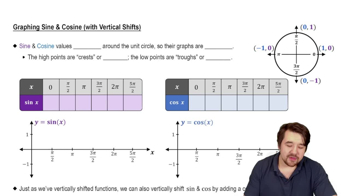
Sine and Cosine Functions

Sine and cosine are fundamental trigonometric functions that relate the angles of a right triangle to the ratios of its sides. The sine function, sin(θ), represents the ratio of the length of the opposite side to the hypotenuse, while the cosine function, cos(θ), represents the ratio of the adjacent side to the hypotenuse. Understanding these functions is crucial for solving problems involving angles and their relationships.
Recommended video:
5:53
Graph of Sine and Cosine Function

Angle Addition Formula

The angle addition formulas for sine and cosine allow us to find the sine or cosine of the sum of two angles. Specifically, cos(α + β) = cos(α)cos(β) - sin(α)sin(β). This formula is essential for calculating the cosine of the sum of angles when the individual angles are known, as in the given problem.
Recommended video:
6:36
Quadratic Formula

Quadrants and Angle Ranges

The range of angles specified in the problem indicates which quadrant the angles α and β lie in. For instance, the range for α is between 0 and π, placing it in the first or second quadrant, while β is between 0 and π/2, placing it in the first quadrant. Understanding the signs of sine and cosine in different quadrants is vital for determining the correct values of these functions when solving trigonometric equations.
Recommended video:
6:36
Quadratic Formula