Ch. 4 - Laws of Sines and Cosines; Vectors
Blitzer - Trigonometry 3rd Edition
Blitzer3rd EditionTrigonometryISBN: 9780137316601Not the one you use?Change textbook
Chapter 4, Problem 1

In oblique triangle ABC, A = 34°, B = 68°, and a = 4.8. Find b to the nearest tenth.

Verified step by step guidance
1
Identify the given information: angle A = 34°, angle B = 68°, and side a = 4.8 opposite angle A.
Calculate the third angle C using the triangle angle sum property: \(C = 180^\circ - A - B\).
Use the Law of Sines to relate sides and angles: \(\frac{a}{\sin A} = \frac{b}{\sin B}\).
Rearrange the Law of Sines formula to solve for side b: \(b = \frac{a \cdot \sin B}{\sin A}\).
Substitute the known values of a, A, and B into the formula and prepare to calculate b (do not compute the final value).

Verified video answer for a similar problem:

This video solution was recommended by our tutors as helpful for the problem above.
Video duration:
2m
Was this helpful?

Key Concepts

Here are the essential concepts you must grasp in order to answer the question correctly.

Angle Sum Property of a Triangle

The sum of the interior angles in any triangle is always 180°. Knowing two angles allows you to find the third by subtracting their sum from 180°, which is essential for solving oblique triangles.
Recommended video:
4:47
Sum and Difference of Tangent

Law of Sines

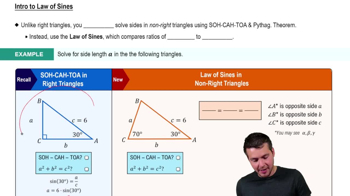
The Law of Sines relates the sides and angles of a triangle: (a/sin A) = (b/sin B) = (c/sin C). It is used to find unknown sides or angles in oblique triangles when given some combination of sides and angles.
Recommended video:
4:27
Intro to Law of Sines

Rounding and Approximation

When solving trigonometric problems, especially with decimals, rounding to a specified precision (here, the nearest tenth) is important for clarity and practical use. This involves using appropriate significant figures after calculation.
Recommended video:
4:45
How to Use a Calculator for Trig Functions