Ch. 4 - Laws of Sines and Cosines; Vectors
Blitzer - Trigonometry 3rd Edition
Blitzer3rd EditionTrigonometryISBN: 9780137316601Not the one you use?Change textbook
Chapter 4, Problem 1

In Exercises 1–8, use the given vectors to find v⋅w and v⋅v. v = 3i + j, w = i + 3j

Verified step by step guidance
1
Identify the components of the vectors \( \mathbf{v} = 3\mathbf{i} + \mathbf{j} \) and \( \mathbf{w} = \mathbf{i} + 3\mathbf{j} \). Here, \( \mathbf{v} = (3, 1) \) and \( \mathbf{w} = (1, 3) \).
Recall the formula for the dot product of two vectors \( \mathbf{a} = (a_1, a_2) \) and \( \mathbf{b} = (b_1, b_2) \): \[ \mathbf{a} \cdot \mathbf{b} = a_1 b_1 + a_2 b_2 \]
Calculate \( \mathbf{v} \cdot \mathbf{w} \) by multiplying corresponding components and adding the results: \[ \mathbf{v} \cdot \mathbf{w} = 3 \times 1 + 1 \times 3 \]
Recall that \( \mathbf{v} \cdot \mathbf{v} \) is the dot product of \( \mathbf{v} \) with itself, which gives the square of its magnitude: \[ \mathbf{v} \cdot \mathbf{v} = 3 \times 3 + 1 \times 1 \]
Evaluate the sums from steps 3 and 4 to find the values of \( \mathbf{v} \cdot \mathbf{w} \) and \( \mathbf{v} \cdot \mathbf{v} \) respectively.

Verified video answer for a similar problem:

This video solution was recommended by our tutors as helpful for the problem above.
Video duration:
2m
Was this helpful?

Key Concepts

Here are the essential concepts you must grasp in order to answer the question correctly.

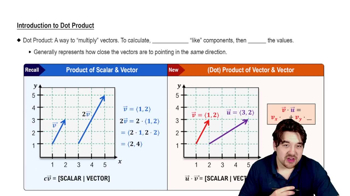
Dot Product of Vectors

The dot product is an algebraic operation that takes two vectors and returns a scalar. It is calculated by multiplying corresponding components of the vectors and summing the results. For vectors v = (v1, v2) and w = (w1, w2), the dot product is v⋅w = v1w1 + v2w2.
Recommended video:
05:40
Introduction to Dot Product

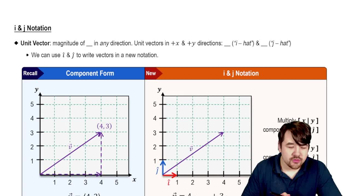
Vector Components and Notation

Vectors in two dimensions are often expressed in terms of unit vectors i and j, representing the x and y directions respectively. For example, v = 3i + j means the vector has components (3, 1). Understanding this notation is essential for performing operations like the dot product.
Recommended video:
06:01
i & j Notation

Properties of the Dot Product

The dot product is commutative, meaning v⋅w = w⋅v, and distributive over vector addition. Also, the dot product of a vector with itself, v⋅v, gives the square of its magnitude, which is useful for finding vector lengths and angles between vectors.
Recommended video:
05:40
Introduction to Dot Product