In Exercises 35–60, find the reference angle for each angle. -13𝜋/3
Ch. 1 - Angles and the Trigonometric Functions

Chapter 1, Problem 1.1.62
In Exercises 57–70, find a positive angle less than or that is coterminal with the given angle. -760°
Verified step by step guidance1
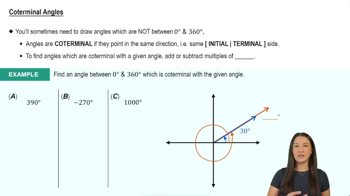
Understand that coterminal angles differ by full rotations of 360°. To find a positive angle coterminal with -760°, we add or subtract multiples of 360° until the angle lies between 0° and 360°.
Start by adding 360° to -760°: calculate \(-760° + 360° = -400°\). Since -400° is still negative, continue adding 360°.
Add 360° again: \(-400° + 360° = -40°\). This is still negative, so add 360° once more.
Add 360° again: \(-40° + 360° = 320°\). Now, 320° is positive and less than 360°, so this is the positive coterminal angle.
Conclude that the positive angle less than 360° coterminal with -760° is 320°.

Verified video answer for a similar problem:
This video solution was recommended by our tutors as helpful for the problem above.
Video duration:
1mWas this helpful?
Key Concepts
Here are the essential concepts you must grasp in order to answer the question correctly.
Coterminal Angles
Coterminal angles are angles that share the same initial and terminal sides but differ by full rotations of 360°. To find a coterminal angle, you add or subtract multiples of 360° from the given angle until the result lies within the desired range.
Recommended video:
Coterminal Angles
Angle Measurement and Positive Angles
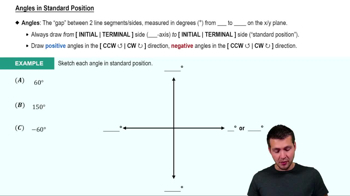
Angles can be measured in degrees and can be positive or negative. A positive angle is measured counterclockwise from the initial side, and when asked for a positive angle less than or equal to 360°, you adjust the given angle accordingly to fit this range.
Recommended video:
Drawing Angles in Standard Position
Modulo Operation with Angles
The modulo operation helps find the remainder when dividing by 360°, effectively reducing any angle to its equivalent between 0° and 360°. This is useful for normalizing angles and finding coterminal angles within a standard interval.
Recommended video:
Algebraic Operations on Vectors
Related Practice
Textbook Question
1
views
Textbook Question
In Exercises 41–56, use the circle shown in the rectangular coordinate system to draw each angle in standard position. State the quadrant in which the angle lies. When an angle's measure is given in radians, work the exercise without converting to degrees.
-210°
14
views
Textbook Question
In Exercises 59–62, use a calculator to find the value of the acute angle θ in radians, rounded to three decimal places. tan θ = 0.4169
5
views
Textbook Question
In Exercises 63–68, find the exact value of each expression. Do not use a calculator. 1 + sin² 40° + sin² 50°
6
views
Textbook Question
In Exercises 63–68, find the exact value of each expression. Do not use a calculator. tan(𝜋/3)/2 - 1/sec(𝜋/6)
1
views
Textbook Question
In Exercises 35–60, find the reference angle for each angle. 17𝜋 / 6
2
views