Ch. 1 - Angles and the Trigonometric Functions
Blitzer - Trigonometry 3rd Edition
Blitzer3rd EditionTrigonometryISBN: 9780137316601Not the one you use?Change textbook
Chapter 1, Problem 1.2.65

In Exercises 63–68, find the exact value of each expression. Do not use a calculator. 1 + sin² 40° + sin² 50°

Verified step by step guidance
1
Recall the Pythagorean identity: \(\sin^2 \theta + \cos^2 \theta = 1\). This identity will help us relate sine and cosine values.
Notice that \(\sin^2 40^\circ\) and \(\sin^2 50^\circ\) are involved. Since \(40^\circ\) and \(50^\circ\) are complementary angles (they add up to \(90^\circ\)), use the complementary angle identity: \(\sin 50^\circ = \cos 40^\circ\).
Rewrite \(\sin^2 50^\circ\) as \(\cos^2 40^\circ\) using the complementary angle identity.
Substitute \(\sin^2 50^\circ\) with \(\cos^2 40^\circ\) in the expression: \(1 + \sin^2 40^\circ + \cos^2 40^\circ\).
Apply the Pythagorean identity to \(\sin^2 40^\circ + \cos^2 40^\circ\), which equals 1, so the entire expression simplifies to \(1 + 1 = 2\).

Verified video answer for a similar problem:

This video solution was recommended by our tutors as helpful for the problem above.
Video duration:
2m
Was this helpful?

Key Concepts

Here are the essential concepts you must grasp in order to answer the question correctly.

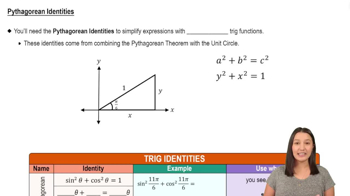
Pythagorean Identity

The Pythagorean identity states that for any angle θ, sin²θ + cos²θ = 1. This fundamental relationship helps simplify expressions involving squares of sine and cosine functions by converting one into the other.
Recommended video:
6:25
Pythagorean Identities

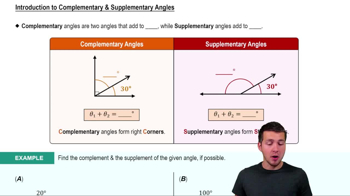
Complementary Angles in Trigonometry

Complementary angles add up to 90°. The sine of an angle equals the cosine of its complement, i.e., sin(θ) = cos(90° - θ). This property allows rewriting sin² 50° as cos² 40°, facilitating simplification.
Recommended video:
3:35
Intro to Complementary & Supplementary Angles

Exact Values and Simplification without Calculator

Finding exact values involves using known identities and angle relationships rather than decimal approximations. By applying identities and angle properties, expressions can be simplified to exact numerical values or simple constants.
Recommended video:
5:08
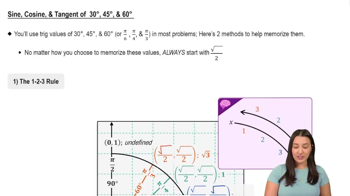
Sine, Cosine, & Tangent of 30°, 45°, & 60°