Concept Check Suppose that the point (x, y) is in the indicated quadrant. Determine whether the given ratio is positive or negative. Recall that r = β(xΒ² + yΒ²) .(Hint: Drawing a sketch may help.) IV , x/y
Ch. 1 - Trigonometric Functions
Chapter 2, Problem 32
Find the measure of each marked angle. See Example 2 complementary angles with measures 3π β 5 and 6π β 40 degrees
Verified step by step guidance1
Recall that complementary angles are two angles whose measures add up to 90 degrees. So, if the two angles are \(3x - 5\) and \(6x - 40\), their sum is \(90\) degrees.
Set up the equation representing the sum of the complementary angles: \[(3x - 5) + (6x - 40) = 90\]
Combine like terms on the left side: \[3x + 6x - 5 - 40 = 90\] which simplifies to \[9x - 45 = 90\]
Solve for \(x\) by first adding 45 to both sides: \[9x = 90 + 45\] then divide both sides by 9: \[x = \frac{135}{9}\]
Once you find the value of \(x\), substitute it back into the expressions for each angle: \[3x - 5\] and \[6x - 40\] to find their measures.

Verified video answer for a similar problem:
This video solution was recommended by our tutors as helpful for the problem above.
Video duration:
3mWas this helpful?
Key Concepts
Here are the essential concepts you must grasp in order to answer the question correctly.
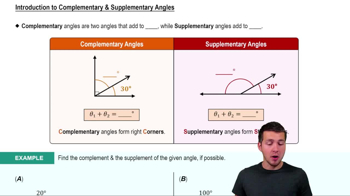
Complementary Angles
Complementary angles are two angles whose measures add up to 90 degrees. Understanding this relationship allows you to set up an equation where the sum of the given angle expressions equals 90, which is essential for solving for the variable.
Recommended video:
Intro to Complementary & Supplementary Angles
Algebraic Expressions in Angle Measures
Angles can be represented using algebraic expressions involving variables. To find the actual angle measures, you need to form and solve equations based on these expressions, applying algebraic techniques such as combining like terms and isolating variables.
Recommended video:
Simplifying Trig Expressions
Solving Linear Equations
Solving for the variable in the angle expressions requires knowledge of linear equations. This involves manipulating the equation formed by the sum of the angles to find the value of the variable, which can then be substituted back to find each angle's measure.
Recommended video:
Solving Linear Equations
Related Practice
Textbook Question
1
views
Textbook Question
Find the values of the six trigonometric functions for an angle in standard position having each given point on its terminal side. Rationalize denominators when applicable. (6β3 , β6)
8
views
Textbook Question
Find the measure of the smaller angle formed by the hands of a clock at the following times.
2
views
Textbook Question
Find the measure of each marked angle. See Example 2 complementary angles with measures 9π + 6 and 3π degrees
2
views
Textbook Question
Determine the signs of the trigonometric functions of an angle in standard position with the given measure. See Example 2.
178Β°
1
views
Textbook Question
Concept Check Suppose that the point (x, y) is in the indicated quadrant. Determine whether the given ratio is positive or negative. Recall that r = β(xΒ² + yΒ²) .(Hint: Drawing a sketch may help.) III , y/r
1
views