Ch. 1 - Trigonometric Functions
Lial - Trigonometry 12th Edition
Lial12th EditionTrigonometryISBN: 9780136552161Not the one you use?Change textbook
Chapter 2, Problem 33

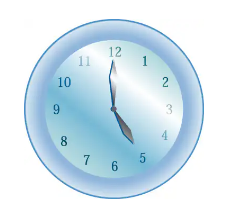
Find the measure of the smaller angle formed by the hands of a clock at the following times.
Clock showing time at 4:58 with hour and minute hands forming a smaller angle.

Verified step by step guidance
1
Understand that the problem asks for the smaller angle between the hour and minute hands of a clock at a given time. The clock is circular, so the angle between the hands can be found by calculating the positions of each hand and then finding the difference.
Calculate the position of the minute hand in degrees. Since the minute hand moves 360 degrees in 60 minutes, its position at \( m \) minutes is given by the formula: \(\text{Minute angle} = 6 \times m\)
Calculate the position of the hour hand in degrees. The hour hand moves 360 degrees in 12 hours, or 30 degrees per hour, plus it moves 0.5 degrees per minute (because it moves continuously). For \( h \) hours and \( m \) minutes, the formula is: \(\text{Hour angle} = 30 \times h + 0.5 \times m\)
Find the absolute difference between the hour and minute angles: \(\text{Angle difference} = |\text{Hour angle} - \text{Minute angle}|\)
Since the clock is circular, the smaller angle between the hands is the minimum of the angle difference and its supplement to 360 degrees: \(\text{Smaller angle} = \min(\text{Angle difference}, 360 - \text{Angle difference})\)

Verified video answer for a similar problem:

This video solution was recommended by our tutors as helpful for the problem above.
Video duration:
1m
Was this helpful?

Key Concepts

Here are the essential concepts you must grasp in order to answer the question correctly.

Angle Measurement in Clocks

The clock is divided into 12 hours, each representing 30 degrees (360°/12). The minute and hour hands move at different rates, and their positions at any given time determine the angle between them.
Recommended video:
05:50
Drawing Angles in Standard Position

Calculating Hour and Minute Hand Positions

The minute hand moves 6 degrees per minute (360°/60), while the hour hand moves 0.5 degrees per minute (30° per hour). To find their positions, calculate the degrees each hand has moved from the 12 o'clock position.
Recommended video:
05:50
Drawing Angles in Standard Position

Finding the Smaller Angle Between Two Hands

After determining the positions of both hands, find the absolute difference between their angles. If this difference is greater than 180 degrees, subtract it from 360 degrees to get the smaller angle formed between the hands.
Recommended video:
04:33
Find the Angle Between Vectors