Ch. 2 - Graphs of the Trigonometric Functions; Inverse Trigonometric Functions
Blitzer - Trigonometry 3rd Edition
Blitzer3rd EditionTrigonometryISBN: 9780137316601Not the one you use?Change textbook
Chapter 2, Problem 105

The graphs of y = sin⁻¹ x, y = cos⁻¹ x, and y = tan⁻¹ x are shown in Table 2.8. In Exercises 97–106, use transformations (vertical shifts, horizontal shifts, reflections, stretching, or shrinking) of these graphs to graph each function. Then use interval notation to give the function's domain and range. f(x) = cos⁻¹ x/2

Verified step by step guidance
1
Identify the base function given, which is the inverse cosine function \(y = \cos^{-1} x\). This function has a domain of \([-1, 1]\) and a range of \([0, \pi]\).
Recognize that the function provided is \(f(x) = \cos^{-1} \left( \frac{x}{2} \right)\), which means the input to the inverse cosine function is transformed by dividing \(x\) by 2.
Determine the domain of \(f(x)\) by setting the inside of the inverse cosine function within its valid domain: \(-1 \leq \frac{x}{2} \leq 1\). Solve this inequality for \(x\) to find the domain of \(f(x)\).
Understand that the range of \(f(x)\) remains the same as the range of \(\cos^{-1} x\), because the transformation is inside the function and does not affect the output values. So, the range is \([0, \pi]\).
To graph \(f(x)\), start with the graph of \(y = \cos^{-1} x\) and apply a horizontal stretch by a factor of 2 (since \(x\) is divided by 2 inside the function). This means the graph will be stretched horizontally, making it wider.

Verified video answer for a similar problem:

This video solution was recommended by our tutors as helpful for the problem above.
Video duration:
6m
Was this helpful?

Key Concepts

Here are the essential concepts you must grasp in order to answer the question correctly.

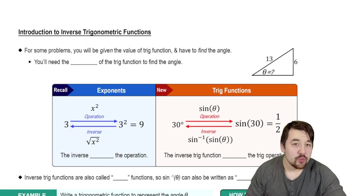
Inverse Trigonometric Functions

Inverse trigonometric functions, such as sin⁻¹x, cos⁻¹x, and tan⁻¹x, return the angle whose trigonometric ratio equals x. They have specific domains and ranges to ensure they are functions, typically restricted to principal values. Understanding these functions is essential for graphing and analyzing their transformations.
Recommended video:
4:28
Introduction to Inverse Trig Functions

Function Transformations

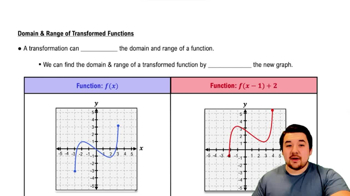
Function transformations include vertical and horizontal shifts, reflections, stretches, and shrinks. These changes alter the graph's position or shape without changing its fundamental nature. For example, replacing x by x/2 horizontally stretches the graph, affecting the domain and range accordingly.
Recommended video:
4:22
Domain and Range of Function Transformations

Domain and Range of Transformed Functions

The domain is the set of input values for which the function is defined, and the range is the set of possible output values. When a function undergoes transformations, its domain and range may change. Using interval notation helps clearly express these sets after applying transformations.
Recommended video:
4:22
Domain and Range of Function Transformations