Ch. 2 - Graphs of the Trigonometric Functions; Inverse Trigonometric Functions
Blitzer - Trigonometry 3rd Edition
Blitzer3rd EditionTrigonometryISBN: 9780137316601Not the one you use?Change textbook
Chapter 2, Problem 99

The graphs of y = sin⁻¹ x, y = cos⁻¹ x, and y = tan⁻¹ x are shown in Table 2.8. In Exercises 97–106, use transformations (vertical shifts, horizontal shifts, reflections, stretching, or shrinking) of these graphs to graph each function. Then use interval notation to give the function's domain and range. f(x) = cos⁻¹ (x + 1)

Verified step by step guidance
1
Identify the base function: here, the base function is the inverse cosine function, written as \(y = \cos^{-1} x\).
Recognize the transformation inside the function: the function is \(f(x) = \cos^{-1} (x + 1)\), which means the input to the inverse cosine is shifted horizontally by -1 (to the left by 1 unit).
Determine the domain of the transformed function by considering the domain of the original \(\cos^{-1} x\), which is \([-1, 1]\). Since the input is \(x + 1\), set \(-1 \leq x + 1 \leq 1\) and solve for \(x\) to find the new domain.
Recall that the range of \(\cos^{-1} x\) is \([0, \pi]\). Since the transformation is only horizontal (inside the function), the range remains unchanged.
Summarize the domain and range in interval notation based on the calculations and transformations applied.

Verified video answer for a similar problem:

This video solution was recommended by our tutors as helpful for the problem above.
Video duration:
6m
Was this helpful?

Key Concepts

Here are the essential concepts you must grasp in order to answer the question correctly.

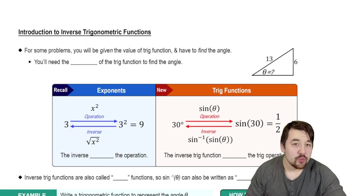
Inverse Trigonometric Functions

Inverse trigonometric functions like cos⁻¹(x) return the angle whose cosine is x. They have specific domains and ranges, for example, cos⁻¹(x) is defined for x in [-1,1] with range [0, π]. Understanding these functions is essential to interpret and graph transformations correctly.
Recommended video:
4:28
Introduction to Inverse Trig Functions

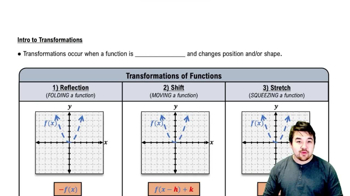
Graph Transformations

Graph transformations include shifts, reflections, stretches, and shrinks applied to a base graph. For f(x) = cos⁻¹(x + 1), the '+1' inside the function causes a horizontal shift left by 1 unit. Recognizing how these transformations affect the graph helps in sketching and determining domain and range.
Recommended video:
5:25
Introduction to Transformations

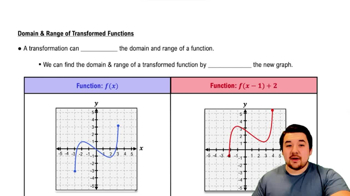
Domain and Range of Transformed Functions

The domain and range of a function can change after transformations. For cos⁻¹(x + 1), the domain shifts accordingly, affecting the input values allowed. Using interval notation to express these sets precisely is crucial for fully describing the function's behavior.
Recommended video:
4:22
Domain and Range of Function Transformations
Related Practice
Textbook Question

In Exercises 83–94, use a right triangle to write each expression as an algebraic expression. Assume that x is positive and that the given inverse trigonometric function is defined for the expression in x. csc (cot⁻¹ x)

Textbook Question

The graphs of y = sin⁻¹ x, y = cos⁻¹ x, and y = tan⁻¹ x are shown in Table 2.8. In Exercises 97–106, use transformations (vertical shifts, horizontal shifts, reflections, stretching, or shrinking) of these graphs to graph each function. Then use interval notation to give the function's domain and range. f(x) = sin⁻¹ x + π/2

3
views
Textbook Question

The graphs of y = sin⁻¹ x, y = cos⁻¹ x, and y = tan⁻¹ x are shown in Table 2.8. In Exercises 97–106, use transformations (vertical shifts, horizontal shifts, reflections, stretching, or shrinking) of these graphs to graph each function. Then use interval notation to give the function's domain and range. f(x) = cos⁻¹ x/2

Textbook Question

The graphs of y = sin⁻¹ x, y = cos⁻¹ x, and y = tan⁻¹ x are shown in Table 2.8. In Exercises 97–106, use transformations (vertical shifts, horizontal shifts, reflections, stretching, or shrinking) of these graphs to graph each function. Then use interval notation to give the function's domain and range. h(x) = −2 tan⁻¹ x

Textbook Question

In Exercises 83–94, use a right triangle to write each expression as an algebraic expression. Assume that x is positive and that the given inverse trigonometric function is defined for the expression in x. ___ sec (sin⁻¹ x/√x²+4)