Ch. 2 - Graphs of the Trigonometric Functions; Inverse Trigonometric Functions
Blitzer - Trigonometry 3rd Edition
Blitzer3rd EditionTrigonometryISBN: 9780137316601Not the one you use?Change textbook
Chapter 2, Problem 97

The graphs of y = sin⁻¹ x, y = cos⁻¹ x, and y = tan⁻¹ x are shown in Table 2.8. In Exercises 97–106, use transformations (vertical shifts, horizontal shifts, reflections, stretching, or shrinking) of these graphs to graph each function. Then use interval notation to give the function's domain and range. f(x) = sin⁻¹ x + π/2

Verified step by step guidance
1
Identify the base function: here, the base function is the inverse sine function, \(y = \sin^{-1} x\), which has a known domain of \([-1, 1]\) and range of \([-\frac{\pi}{2}, \frac{\pi}{2}]\).
Understand the transformation applied: the function \(f(x) = \sin^{-1} x + \frac{\pi}{2}\) represents a vertical shift of the graph of \(y = \sin^{-1} x\) upward by \(\frac{\pi}{2}\) units.
Apply the vertical shift to the range: since the original range is \([-\frac{\pi}{2}, \frac{\pi}{2}]\), adding \(\frac{\pi}{2}\) to each value shifts the range to \([0, \pi]\).
Determine the domain of \(f(x)\): the domain remains unchanged by vertical shifts, so the domain is still \([-1, 1]\).
Summarize the transformed graph: the graph of \(f(x)\) is the graph of \(y = \sin^{-1} x\) shifted up by \(\frac{\pi}{2}\), with domain \([-1, 1]\) and range \([0, \pi]\).

Verified video answer for a similar problem:

This video solution was recommended by our tutors as helpful for the problem above.
Video duration:
3m
Was this helpful?

Key Concepts

Here are the essential concepts you must grasp in order to answer the question correctly.

Inverse Trigonometric Functions

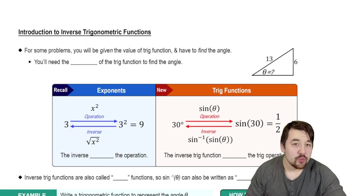
Inverse trigonometric functions, such as sin⁻¹x, cos⁻¹x, and tan⁻¹x, return the angle whose trigonometric ratio equals x. They have specific domains and ranges to ensure they are functions, for example, sin⁻¹x has domain [-1,1] and range [-π/2, π/2]. Understanding these restrictions is essential for graphing and transformations.
Recommended video:
4:28
Introduction to Inverse Trig Functions

Graph Transformations

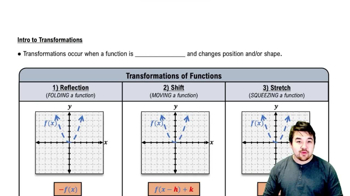
Graph transformations include vertical and horizontal shifts, reflections, stretches, and shrinks that modify the parent function's graph. For f(x) = sin⁻¹x + π/2, adding π/2 shifts the graph vertically upward by π/2 units, affecting the range but not the domain. Recognizing these changes helps in sketching the transformed graph accurately.
Recommended video:
5:25
Introduction to Transformations

Domain and Range of Transformed Functions

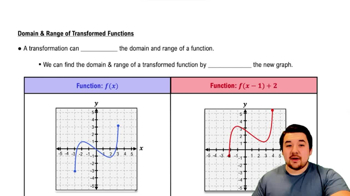
The domain of inverse trig functions is determined by the input values for which the function is defined, while the range is the set of possible output values. Transformations like vertical shifts alter the range but typically leave the domain unchanged. Expressing domain and range in interval notation clarifies these sets precisely.
Recommended video:
4:22
Domain and Range of Function Transformations
Related Practice
Textbook Question

In Exercises 83–94, use a right triangle to write each expression as an algebraic expression. Assume that x is positive and that the given inverse trigonometric function is defined for the expression in x. sec (cos⁻¹ 1/x)

Textbook Question

In Exercises 83–94, use a right triangle to write each expression as an algebraic expression. Assume that x is positive and that the given inverse trigonometric function is defined for the expression in x. csc (cot⁻¹ x)

Textbook Question

The graphs of y = sin⁻¹ x, y = cos⁻¹ x, and y = tan⁻¹ x are shown in Table 2.8. In Exercises 97–106, use transformations (vertical shifts, horizontal shifts, reflections, stretching, or shrinking) of these graphs to graph each function. Then use interval notation to give the function's domain and range. f(x) = cos⁻¹ x/2

Textbook Question

The graphs of y = sin⁻¹ x, y = cos⁻¹ x, and y = tan⁻¹ x are shown in Table 2.8. In Exercises 97–106, use transformations (vertical shifts, horizontal shifts, reflections, stretching, or shrinking) of these graphs to graph each function. Then use interval notation to give the function's domain and range. f(x) = cos⁻¹ (x + 1)

1
views
Textbook Question

The graphs of y = sin⁻¹ x, y = cos⁻¹ x, and y = tan⁻¹ x are shown in Table 2.8. In Exercises 97–106, use transformations (vertical shifts, horizontal shifts, reflections, stretching, or shrinking) of these graphs to graph each function. Then use interval notation to give the function's domain and range. h(x) = −2 tan⁻¹ x

Textbook Question

In Exercises 83–94, use a right triangle to write each expression as an algebraic expression. Assume that x is positive and that the given inverse trigonometric function is defined for the expression in x. ___ sec (sin⁻¹ x/√x²+4)