Textbook QuestionLet A = {-6, -12⁄4, -5⁄8, -√3, 0, ¼, 1, 2π, 3, √12}. List all the elements of A that belong to each set. Rational numbers
Textbook QuestionLet A = {-6, -12⁄4, -5⁄8, -√3, 0, ¼, 1, 2π, 3, √12}. List all the elements of A that belong to each set. Irrational numbers
Textbook QuestionLet A = {-6, -12⁄4, -5⁄8, -√3, 0, ¼, 1, 2π, 3, √12}. List all the elements of A that belong to each set. Real numbers
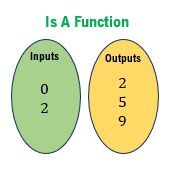
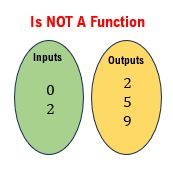
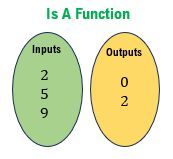
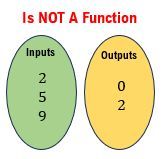
Multiple ChoiceState the inputs and outputs of the following relation. Is it a function? {(−3,5),(0,2),(3,5)\(\left\)(-3,5\(\right\)),\(\left\)(0,2\(\right\)),\(\left\)(3,5\(\right\))(−3,5),(0,2),(3,5)}7views
Multiple ChoiceIs the equation y=−2x+10y=-2x+10y=−2x+10 a function? If so, rewrite it in function notation and evaluate at f(3)f\(\left\)(3\(\right\))f(3).2views
Multiple ChoiceIs the equation y2+2x=10y^2+2x=10y2+2x=10 a function? If so, rewrite it in function notation and evaluate at f(−1)f\(\left\)(-1\(\right\))f(−1).6views
Multiple ChoiceFind the domain and range of the following graph (write your answer using interval notation).1views
Multiple ChoiceFind the domain of f(x)=x+4f\(\left\)(x\(\right\))=\(\sqrt{x+4}\)f(x)=x+4 . Express your answer using interval notation.3views




 Verified step by step guidance