Ch. 2 - Acute Angles and Right Triangles
Lial - Trigonometry 12th Edition
Lial12th EditionTrigonometryISBN: 9780136552161Not the one you use?Change textbook
Chapter 3, Problem 2.R.25

Use a calculator to approximate the value of each expression. Give answers to six decimal places. sec 222° 30'

Verified step by step guidance
1
Convert the angle from degrees and minutes to decimal degrees. Since 30' means 30 minutes, and 1 degree = 60 minutes, calculate the decimal degrees as \(222 + \frac{30}{60}\).
Recall that \(\sec \theta = \frac{1}{\cos \theta}\). So, to find \(\sec 222^\circ 30'\), you first need to find \(\cos 222.5^\circ\) (the decimal degree equivalent).
Use a calculator set to degree mode to find the value of \(\cos 222.5^\circ\).
Calculate the secant by taking the reciprocal of the cosine value: \(\sec 222.5^\circ = \frac{1}{\cos 222.5^\circ}\).
Round your final answer to six decimal places as requested.

Verified video answer for a similar problem:

This video solution was recommended by our tutors as helpful for the problem above.
Video duration:
2m
Was this helpful?

Key Concepts

Here are the essential concepts you must grasp in order to answer the question correctly.

Understanding the Secant Function

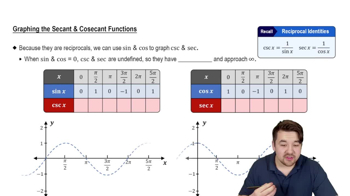
The secant function, sec(θ), is the reciprocal of the cosine function, defined as sec(θ) = 1/cos(θ). To find secant values, you first calculate the cosine of the angle and then take its reciprocal. This relationship is fundamental when working with trigonometric expressions involving secant.
Recommended video:
6:22
Graphs of Secant and Cosecant Functions

Converting Degrees and Minutes to Decimal Degrees

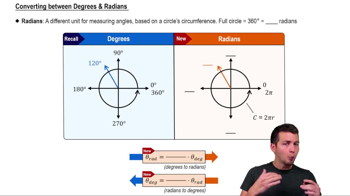
Angles given in degrees and minutes must be converted to decimal degrees for calculator use. Since 1 minute equals 1/60 of a degree, convert 30' to 0.5°, so 222° 30' becomes 222.5°. This conversion ensures accurate input for trigonometric calculations on calculators.
Recommended video:
5:04
Converting between Degrees & Radians

Using a Calculator for Trigonometric Approximations

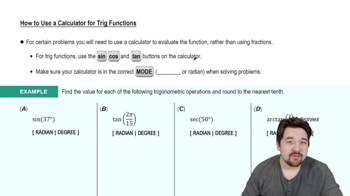
Calculators typically require angles in decimal degrees or radians to compute trigonometric functions. After converting the angle, input it correctly, ensure the calculator is in degree mode, compute cos(θ), then find sec(θ) by taking the reciprocal. Finally, round the result to six decimal places as requested.
Recommended video:
4:45
How to Use a Calculator for Trig Functions